Monday, July 4, 2011

Noble & Cooley Featured in Boston Globe Article

Note: This story from the Boston Globe's website and hard copy paper.

See also "Noble & Cooley To Re-Issue Civil War Drums to Commemorate War's 150th Anniversary in 2011," this blog, Sep. 1, 2010.

-----

Drum maker draws on its past for better future
Replica snares help Granville firm endure

By James Sullivan
Globe Correspondent / June 29, 2011 (Business Section, p. B5)
© Copyright 2011 Globe Newspaper Company.

GRANVILLE — They are still managing to keep time at Noble & Cooley, a Civil War-era drum company in Western Massachusetts.

After decades as one of the country’s biggest suppliers of toy drums, Noble & Cooley in the 1980s branched out to make state-of-the-art drum kits, with customers that included Phil Collins and Paul McCartney. But the bleak holiday shopping season that followed the Sept. 11, 2001, terrorist attacks nearly led to the company’s demise. As during other trying times in its history, Noble & Cooley somehow persevered, even as it got smaller.

Today, the company is trying to remain relevant by capitalizing on its rich heritage. To commemorate the 150th anniversary of the start of the Civil War, Noble & Cooley is producing replicas of the snare drums Union soldiers used to communicate on the battlefield. It is also one of 100 finalists in the This Place Matters grant challenge, sponsored by the National Trust for Historic Preservation. Online voting closes tomorrow, with the top vote-getter receiving $25,000.

“We’re doing everything we can to hang on,’’ said Jay Jones, the company president. He is a sixth-generation descendant of cofounder James P. Cooley, who began making drums in Silas Noble’s kitchen in 1854.

Once a holiday season powerhouse, with a peak of 120 employees two decades ago, Noble & Cooley is now a true mom-and-pop shop. There are just three full-time workers: Jones; his wife, Carol; and their 27-year-old son, Nick.

When he first joined his father in the family business, Jones, 57, shifted some of the emphasis away from the toys that had been a staple for years. Thanks to the rich tone of its natural wood drums (most contemporary drums, including some of Noble & Cooley’s, are plywood), the company quickly attracted a loyal customer base among some of the world’s top musicians.

Collins once appeared in an endorsement advertisement alongside an image of Abe Lincoln. Noble & Cooley’s cofounders made a presidential campaign drum for Lincoln in 1860, using wood that he had chopped years before.

Jonathan Mover, an acclaimed drummer and the editor in chief of Drumhead magazine, found out about Noble & Cooley drums from musician Chris Whitten, who used to play with McCartney. Mover bought two limited-edition snares years ago.

“They’re absolutely two of the finest snares I have,’’ said Mover, a Peabody native who also runs Skyline Recording in New York. “And I have got a serious collection, over a hundred.’’

Mover credits Noble & Cooley’s commitment to quality as an inspiration for larger drum companies, such as Yamaha, Pearl, and Tama.

“All the big companies are making very high-end gear, which they really didn’t do years ago,’’ he said. Unfortunately, Mover said, that has created considerable competition for a small, family business such as Noble & Cooley.

The company still builds several dozen custom drum kits (some of which sell for up to $10,000) and as many as 500 solid-wood snares each year. Although it’s not the first time the drum company has faced adversity.

History of Noble & Cooley

Few episodes, however, were as devastating as the economic plunge that followed Sept. 11, 2001. That downturn effectively wrecked the company’s toy business, which had reached a peak of $3 million in annual sales in the late 1970s. Noble & Cooley was left holding two dozen containers of unsold toy instruments imported from China when some of its biggest clients, including Sears and JC Penney, canceled holiday orders.

“The bank started running scared,’’ said Jones. “They called in the note. It took me six years to pay off’’ the bank. To do so, he had to sell off hundreds of acres of family property in this rolling farmland west of Springfield.

The Noble & Cooley compound — three big old buildings with tilting floors, connected on the upper levels by iron pedestrian bridges — is a much quieter place today than it was at the height of toy production. In fact, one building isn’t even used.

Walking around the factory on a recent Friday, Jones was called away to help unload machine parts from a delivery truck. As a light drizzle fell outside the loading dock, the driver looked around the barn-like warehouse, which was mostly empty.

“I totally forgot this place was here,’’ he said.

A cardboard pallet box sat off to one side, full of tin tambourines featuring characters from Jim Henson’s old “Fraggle Rock’’ series. Their plastic sleeves had long since grown moldy.

Nick Jones helped his father empty the truck. He plays bass in a metal band with his older brother, Jonathan. Jonathan, a graphic designer with waist-length dreadlocks, is the real drummer in the family, said Jay Jones.

“I play the radio,’’ he joked.

When they were kids, Nick and Jonathan had the run of the place.

“It was awesome,’’ said Nick. “There were tons of cardboard boxes to play in. We played with tin scraps. We were obnoxious.’’

Now, the boy who once terrorized seasonal employees actually does have the run of the place. Reduced to such a tiny operation, these days it takes the company eight to 10 weeks to fill a custom drum order. The process to make a Civil War replica snare — steaming, bending, aging, and curing — requires 16 weeks.

Jay Jones and his son assemble each reproduction drum, made of steam-bent tulipwood, using the same heavy, belt-driven machinery that employees operated more than a century ago.

Noble & Cooley took one of the drums, which are numbered, to the most recent Gettysburg Remembrance Day event last fall. “People were throwing credit cards at us to get a low serial number,’’ said Jones.

Having retrenched, the family knows that the value of its product is directly related to the time and care they put into it.

Jones, smiling, credited a friend with his new philosophy.

“There’s no such thing as a drum emergency,’’ he said.


Photo Credit: Matthew Cavanaugh for The Boston Globe

This year marks the 150th anniversary of the Civil War. To commemorate the occasion, Noble & Cooley, a drum company in Granville, will be producing replicas of the snare drums that Union soldiers played on the battlefield as a form of communication.

The small, family-owned company goes back even further than this moment in history, back to 1854, and is still pounding away at business. Click through the slides to see a behind-the-scenes look at the factory and a peek into its history.

Photo Credit: Matthew Cavanaugh for The Boston Globe

Jay Jones, 57, pictured here, is the president of Noble & Cooley and a sixth generation drum maker, a direct descendant of the company's founder, James P. Cooley. Despite struggling through fires, the Great Depression, World War II, and the holiday season following 9/11, all of which have put the company at risk, it still continues to make drums of all kinds, such as replicated snare drums, and even at one point made drum kits for some of the world's top musicians.

Photo Credit: Matthew Cavanaugh for The Boston Globe

The company turned to making state-of-the-art drum kits in the 1980s. Capitalizing on the rich tone of natural wood drums, the company quickly attracted a loyal customer base that included Phil Collins and Paul McCartney.

Jonathan Mover, an acclaimed drummer and the editor-in-chief of Drumhead magazine, credits Noble & Cooley’s commitment to quality as an inspiration for the larger drum companies, such as Yamaha, Pearl and Tama.

“They’re absolutely two of the finest snares I have,” said Mover.

Photo Credit: Matthew Cavanaugh for The Boston Globe

The company peaked in the late 1970s with a top annual revenue of $3 million. At one point, it had 120 seasonal employees. However, there was a downturn after Noble & Cooley was left holding two dozen containers of unsold toy instruments imported from China when some of its biggest retailers essentially canceled Christmas following the 9/11 attack.

“The bank started running scared,” says Jones. He had to sell off hundreds of acres of family property to pay back the banks.

Pictured: old products on display in the museum.

Photo Credit: Matthew Cavanaugh for The Boston Globe

All of the drums are handmade, crafted by one of the company's three employees: Jones, his wife Carol, and their son Nick Jones, 27. They make use of heavy, belt-driven machinery, much of which was in use over a century ago. Each drum is made of steam-bent tulipwood. Here, a red oak shell for a snare drum is lathed.

Photo Credit: Matthew Cavanaugh for The Boston Globe

In addition to filling orders, the company also doubles as a museum. The Society of Industrial Archeology visited the old factory, took a look at the old machinery, and recommended preservation. Now Noble & Cooley is one of 100 finalists in a grant challenge sponsored by the National Trust for Historic Preservation called This Place Matters. Online voting closes on June 30. The top vote-getter will receive $25,000.

Photo Credit: Matthew Cavanaugh for The Boston Globe

Here, Nick Jones sands a red oak shell for a drum. He is a musician too. He plays the bass in a band with older brother Jonathan, who is the real family drummer.

-----

Notable Products in the 157-year history of Noble & Cooley:

- A presidential campaign drum in 1860 for Abraham Lincoln, using wood Lincoln had chopped years before.

- Giftware in the '60s and early '70s that included waste baskets, ice buckets, lamps and cutting boards.

- Toy drums for retailers such as Sears and JC Penney

- State-of-the-art custom drum kits for Phil Collins and a drummer for Paul McCartney's band.

- Replicas of the snare drums used by Union Soldiers on Civil War battlefields to convey messages.

Employees:

1854: 2
Founders Silas Noble and James P. Cooley.

1980s: 120

2011: 3
Jay Jones, a descendant of Cooley, his wife Carol, and son Nicholas.

Tuesday, June 14, 2011

Snare Science -- A Major Contribution to Rudimental Drumming

A bloging engineer going by the name flamdraggrid has created a wonderful website to which you are referred. The site has tons of information on rudimental drumming as well as a good many charts. flamdraggrid admits to having played with Minnesota Brass and Madison Scouts, as well as the University of Minnesota drumline.

Snarescience.com helps the drumming community directly by providing free exercises with thorough explanations, articles about drumming, and research into the latest literature and technology that can be used to enhance one's drumming ability.

Snare Science presented "Grid University", an online educational series in Summer 2010, hosted by snare drummer Kevin Troyanos.

Grid University is intended to be a bi-weekly educational series designed to help expand the rhythmic vocabulary of all drummers, from beginners to advanced, rudimental to drum set.

The "Grid" is an exercise model used by drummers to quickly and efficiently learn and practice various rhythms in different contexts. They are designed to exploit mathematical permutations to efficiently learn all possible ways a rhythm can be played. This series will explore various grid patterns, and build from the very simple to the extremely advanced.


-----

Kevin Troyanos

Kevin began his marching career with the White Plains High School marching band from White Plains, New York. Receiving the John Philip Sousa Award upon graduation, he joined up with the Rutgers University Drumline marching both in the snare line as well as the quad line. Kevin is a current member of the 6-time DCA Champion Bushwackers Drum and Bugle Corps, having marched in the "All Star" snare line of 2008, and then again in 2009 as section leader of the Quad Line. Kevin's teaching experience includes the Percussion Caption Head position with the well respected NJ State Champion Edison High School Marching Band and Indoor Program. He also specializes in private instruction, both online and off. Known for his mathematical and analytical background, Kevin strives to bring the scientific method as well as cutting-edge educational methods through the use of technology to the forefront of Marching Percussion. He is currently studying Mathematics at the University at Buffalo. Visit Kevin's Youtube page at: http://www.youtube.com/optsyn

Grid U - An American Rudimental Legacy: The West Point Hellcats


Grid University is proud to present the original documentary:

An American Rudimental Legacy: The West Point Hellcats

Produced by Kevin Troyanos

The Hellcats:

The DrumCats are comprised of rudimental drummers from the West Point Band's "The Hellcats." Equipped with instruments designed and hand-made specifically for them, the DrumCats enable the West Point Band to maintain faithful renditions of traditional American military music while providing the Corps of Cadets with a piece of living history.

SGM Eric Sheffler
SSG William Calohan
SSG William Cuthbert
SSG Andrew Porter
SSG Jeff Prosperie

Sunday, May 29, 2011

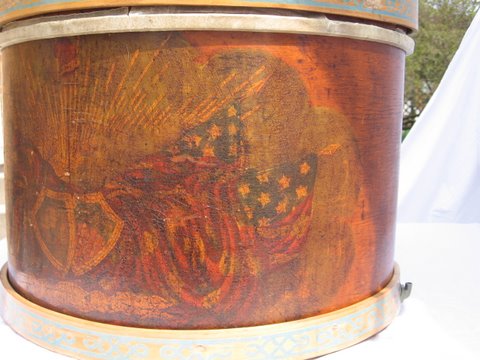
A Painted William S. Tompkins Drum Shows Up

Don Sorensen, a reader of this blog, wrote and sent photos of this unique drum:

Hi, I don't think the lettering will show up. The gilt banner at the lower center of the painting has W S TOMPKINS MAKER and then what looks like 60 WATTS S N Y. It is red lettering on the gold and is very faint. The hoops seem to fit exactly with wear patterns matching the drum. There is a pewter type tube attached that was part of the snare. The ghost of the snare is very visible on the bottom skin. The drum body appears to be birdseye maple, with no label inside. The top skin is broken, and the ring used to hold it on is tight and won't slide off. The patina is really great, and the painting is very detailed. One shield is the federal shield, haven't figured the other one out yet. Thanks, Don

I sent you 11 photos. I found this exact motif on a patriotic Civil War token. I don't know if it's clear enough, but there is a pole in the center of the drum painting with a liberty cap on top. The grommet hole appears to be ivory or bone. One drum skin is broken, the other is intact with the shadow of the snare visible on the skin. The hoops fit the drum exactly and also appear to be hand painted. That's about all I know except what I read on your website.


If anyone can shed some light on the painted emblazonment or any other aspect of this drum, please write to us at BlogMaster@FieldDrums.com.

This drum is the first Tompkins drum we have found that lacks the signature inlay designs and that carries only a painted emblazonment.

Editor's Note: The painted hoops with their repeating design might be later than the CW period. We've seen black stenciled designs on drums of the late 19th century.

See "Tompkins 1860-1863 Masterpiece Drums -- Where Are They Now?", this blog, Feb. 27, 2008. And see other articles on this blog re Tompkins drums by searching (upper left search box) for Wm. S. Tompkins.

# # #

Friday, May 20, 2011

1833 Eli Brown Drum, No. 712

Mark Sampson, a reader of this blog, sent the below photos to us asking where he might get it appraised. He referred to it as an 1833 "Eli Drum" (possibly referring to Eli Brown).


Mark wrote:


To my knowledge I do not believe there has been any restoration done to this drum. I tried to take a photo through the air hole but it did not work.

"Eli Brown,
Drum Manufacturer,
Then there appears to be a drawing or printing of a Bass Drum
Has Consistently For Sale"

Then in Bold Print

"Bass and Snare Drums
Made in the Neatest and Best Manor
Windsor (Winterbury Soc.) Conn 1833 No. / 712"

The sticker has some boarder around it. The #3 in 1833 is hand written as is the 712.


Diameter = 17 ½ “
Height = 13 ½ “
Circumference = 48 ½”


"There are 13 missing tacks. They seem to be missing at the outer edges of the drum. Very interesting design with diamonds and circle around the vent hole. I do not think it was restored but would appreciate any information. I think it is a real nice piece of Americana and want to make sure it is preserved for the future."


The painting on the drum is unique. I've not seen a painting quite like it.

Whoever did the restoration on this drum appears to have installed the tugs upside-down. And the tugs appear to have been stained to look old (but the inside surfaces and cut edges are clearly new, as is the rope).

A very good craquelure (a network of fine cracks or crackles on the surface of a painting, caused chiefly by shrinkage of paint film or varnish), or wood grain underlying the paint, appears all over the painted surface of the drum.


The vent hole appears to have a bone grommet (although excessively white for real bone) through which a small part of a label appears to be visible (click on the photo to enlarge it and you'll be able to see what looks like part of a printed label). A few tacks near the flesh hoops appear to have been lost or removed.

The tack pattern is clearly like those on known Brown drums of the early 19th century.

Remnants of what appears to be a period snare mechanism can be seen on the bottom hoop near the snare gate. And the presence of a person's thumb (bottom left) suggests that the drum might be smaller than a usual field drum, perhaps closer to a child's toy drum size, but I cannot tell for sure from the photo.


WHAT WE HEAR FROM THE EXPERTS:

Susan Cifaldi wrote:


Obviously this is cut down and parts have been recycled (the leather ears were cut from a large piece that was previously seamed (one ear is "inside-out"), and top hoop looks like it's from an older drum to me).

Looks like someone replaced the grommet (bone doesn't yellow with age as much as ivory does, but it does yellow, and there should be at least some dullness to the white, as you correctly point out) It's curious that there is no shellac over the entire shell, just over the painted part.

It could have been removed at some point in time, but I've seen that on a few Stevens drums, where they shellacked over the artwork only. However, the Browns wouldn't do that since it doesn't look like they offered artwork at the point of sale, what we see on the few extant
decorated drums has been obviously added later.

If the owner knows it is 1833, I'm thinking it is on the label. Can he send us a transcription of it?

Looking at the areas where the tacks are missing, I think the cut-down was done some years ago.

Also, can he tell us anything about provenance? That might help us trace the art work.

I'd like to call it a Brown drum, but let's see what the label says. Maybe the owner can help us out with that.


Susan Cifaldi wrote also:

Thanks, Mark and Ellis! We knew it was cut down, and this is now verified by the number and date you supplied, indicating that this would have been a more or less "square" drum. Lots of these drums were cut down to this size around the time of the Civil War; by that time the big square drums were outdated. 

If there is enough label left, I might urge Mark to take a look to see if it is indeed "Eli Brown" and not "Eli Brown & Son," the reason being it's right on the cusp of when Eli's son was taken in as a partner. . if not, it is still a lovely example of Brown's work. 

The artwork deserves a closer look, in my opinion. Mark, where did you find the drum? Did the former owner give you any information about where (s)he found it? 

Thanks again for posting it, and keep us informed of where it goes if you do sell it. 

Monday, May 16, 2011

eBay seller shadrowschoice ( 1627), item no. 120725371661 wrote:

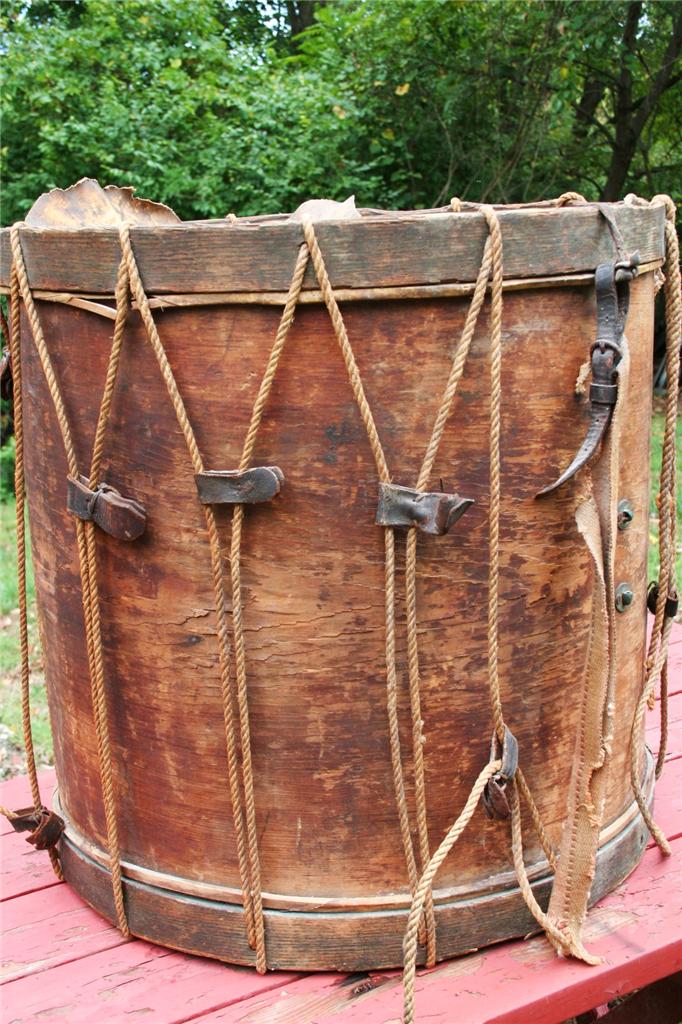
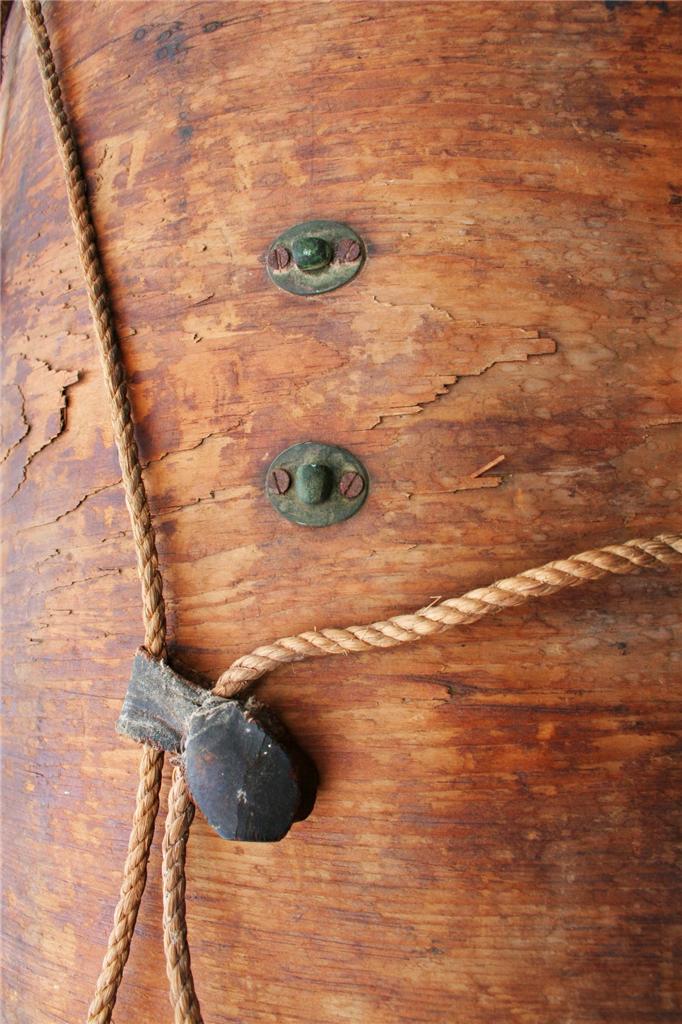
OFFERED FOR AUCTION IS AN IMPRESSIVE RARE ANTIQUE AMERICAN CIVIL WAR ERA FIELD DRUM. LARGE WOODEN DRUM MEASURES 24 1/4" HIGH AND 25" IN DIAMETER. DECORATED WITH BRASS TACKS IN A ROUND PATTERN AROUND THE VENT HOLE. THERE IS SMALL BRASS HARDWARE ON THE OPPOSITE SIDE. I BELIEVE IT HAS WHAT'S LEFT OF THE ORIGINAL SKIN HEADS AND EARLY TIGHTENING ROPES WITH LEATHER. RIMS ARE STAINED WITH OLD BLUE PAINT. INSIDE THERE IS WRITING AND A FRAGMENT OF AN EARLY NEWSPAPER, AS SHOWN IN LAST PHOTOS. I COPIED THE WRITING ON A SHEET OF WHITE PAPER-SEE VERY LAST PHOTO. NO CRACKS IN BODY, JUST PERIOD WEAR. A BEAUTIFUL RARE DRUM OF CIVIL WAR TIMES.


Postcard: National Association of Civil War Musicians


eBay item no. 290546390247, Seller kamich09 ( 888) asking $199.99 BIN price.

Susan Cifaldi wrote:

Wow! I think that's what I paid for mine, and it came with Bogart's personal copy of the 1905 edition of the AVF, another postcard of a GAR encampment, and the fife he used there. (the GAR card is inscribed to his sister, and he complains about the weather). The NACWM was a fine group who fought hard to keep the field music alive in the GAR (there was evidently a move to lessen musical activities around 1911).

An 1862 A. Rogers Eagle Drum Shell Surfaces

Shannon, a reader of this blog, wrote today with photos of a drum shell purchased recently in a thrift shop in Vermont (the drum was on a top shelf with Stetson hat boxes).

The drum shell appears to be an Army surplus (because no regiment number was painted in) contract eagle drum made in 1862 (date appears handwritten in pencil on the label) by A. Rogers of Flushing, Long Island (Flushing is a section in the north central part of Queens County, New York City, New York, east of New York County a/k/a Manhattan; it was consolidated into the City of New York in 1898 together with two other towns to form Queens County; at the time that this drum was made (1862), Flushing was a town on Long Island).

The shell's painting looks authentic, largely intact with only minor paint flaking.


Below is a photo of another A. Rogers eagle drum discussed in a post to this blog, Sunday, January 11, 2009, titled, "A. Rogers Manufacturing Civil War Infantry Drum." Note the similar painting.


Also, note that the 1862 drum shell is shorter than the other Rogers drum's shell. It was probably cut down to serve the needs of a smaller drummer, or more likely in my guesstimation to fit in with later times' styles. The emblazonment on the other Rogers drum clears the counterhoops with plenty of space to spare. By comparison, the 1862 drum's emblazonment would be partially covered by counterhoops if converted to a player, like this 1864 A. Rogers eagle drum discussed in post "An 1864 A. Rogers Civil War Field Drum (and a Repro)," this blog, March 7, 2010.


Additional photos of the 1862 drum:


However, note the addition of a non-Civil War snare strainer (I've seen snare strainers like this on drums ca. 1915. See, e.g., this WWI era Ludwig catalog, ca. 1918-1924):


And see this WWI era drum (ca. 1915) in my collection, with its WWI era snare strainer (bottom right):


A close-up of the WWI-era snare strainer:

And see this WWI Ludwig snare drum with Union Shield discussed in "WWI Ludwig Snare Drum with Union Shield and Drumsticks," this blog, Sunday, June 1, 2008:

Another Civil War eagle drum with a similar snare mechanism can be seen in my article titled, "Heavily Tacked Regimental Field Drum Attracting Interest on eBay," this blog, Wednesday, December 3, 2008. In that post, I refer to the snare mechanism as an anachronistic error:


It is doubtful that a drum maker would have gone to the trouble of creating a wonderfully symetric tack pattern, only to cover it up by a slightly off-center snare mechanism.  That, together with other evidence concerning the snare mechanism's early 20th century origin, leads me to think that the snare mechanism was added during the early 20th century.

One could consider the snare mechanism like scholars consider the 19th century initials and names that are carved into the millennia-old monuments at Luxor and Giza in Egypt: historical graffiti.  Or, if I owned the drum, I would consider the snare mechanism just adulteration and remove it, restoring the drum to its original design.

The A. Rogers label with handwritten "1862" appears through the drum's vent hole.


See also "An 1864 A. Rogers Civil War Field Drum (and a Repro)" in the Sunday, March 7, 2010 edition of our blog at http://blog.fielddrums.com/2010/02/1864-rogers-civil-war-field-drum-and.html.

Tuesday, May 10, 2011

Rope Drum Maintenance by USMA SSG Andrew Potter


SSG Andrew Porter of the Hellcats walks through the steps of piecing together a rope-tensioned snare drum. Look for a second video coming soon on applying tension and finishing touches to your rope drum. Visit www.westpointband.com or subscribe to our YouTube channel for more videos.

Charles W. Dickerson Fife, Drum & Bugle Corps of New Rochelle, New York

(Summary by Perplexity.AI) The Charles W. Dickerson Fife, Drum & Bugle Corps is a historic musical group based in...