501 Broadway, NYC - 1867 and 2019 - 7th Regiment Parading before Shipping Off to the Civil War
“Build it and they will drum.” Dedicated to research, study and comparisons of field drums. Our purpose is to collect information about historical U.S. drums (manufacture, preservation, conservancy, repair, market) for use by scholars, collectors and others. Photographs of drums, and anything related, together with informative narratives, are welcome. Interested readers will find archived postings a good resource. Reach us at emirsky@gmail.com.
Sunday, April 12, 2020
Saturday, April 11, 2020
The Drumslingers: LES PARKS UN-TRADITIONAL SNARE GRIP
A great post by E.W. Flack
Read it at http://thedrumslingers.blogspot.com/2009/09/left-hand-pinky-finger-out-snare-drum.html.
And watch the linked video at https://youtu.be/c_SkLdNM5VI.
Read it at http://thedrumslingers.blogspot.com/2009/09/left-hand-pinky-finger-out-snare-drum.html.
And watch the linked video at https://youtu.be/c_SkLdNM5VI.
Sunday, March 15, 2020
Harrison Tyler ("Tip") Prentiss - Civil War Drummer Boy
-----
Biography of Harrison Tyler Prentiss
Posted to Ancestry.com 26 Apr 2012 by Walter WaggonerBiography of Harrison Tyler “Tip” Prentiss
https://www.ancestry.com/mediaui-viewer/tree/39903005/person/19425250118/media/a8e57691-0876-4112-9271-f9d1cfc24cc2
The Prentiss family moved from Missouri to Quincy, Illinois about the time of his birth, most indicating that it was in 1840 when his father Benjamin and mother Margaret and the Prentiss clan, including his grandfather Henry Leonidas and grandmother Rebecca also made the short trip over the Mississippi River east to a free state. Little is known of Tip’s childhood.
By the time of the census of 1860, Tip was listed as an apprentice steamboat pilot, a profession he followed later in life. A more famous contemporary steamboat pilot was Mark Twain, also of Marion County, Missouri, where the Prentiss family had first settled. However, Samuel Clemons was leaving the profession about the time that Tip was beginning.
With the outbreak of war in 1861, Tip followed his father and enlisted in the Tenth Illinois Infantry Regiment. After his ninety day term was up, he returned home and later enlisted as a drummer in the Fiftieth Illinois Regiment. After his ninety day term was up, he returned home and later enlisted as a drummer in the Fiftieth Illinois Regiment. Tip transferred from the Fiftieth Illinois to the Eighty-fourth Illinois where he also served as a musician. Tip participated in the battles of Ft. Henry, Ft. Donelson, Ft. Pillow, Shiloh, Lookout Mountain and Missionary Ridge.
Tip transferred from the Fiftieth Illinois to the Eighty-fourth Illinois where he also served as a musician. Tip participated in the battles of Ft. Henry, Ft. Donelson, Ft. Pillow, Shiloh, Lookout Mountain and Missionary Ridge.
At the Battle of Shiloh Tip, ran to the rear, as did so many men during the first day of battle. While Tip was running away from the battlefield front, his father was busy trying to hold the line at the Hornet’s Nest against the Confederate onslaught. It was said that as Tip ran for the rear he met up with an aide to his father. According to the story Tip asked, “Where is the old man?” The aide replied that, “He’s out there where you hear all that fighting.” Tip responded saying, “Well, if he is out there one member of the family in the fight is enough, I’m going to the river.” When Tip ran for the safety of the bank of the river, he had plenty of company.
Tip was well liked throughout his life. It was claimed that he was “the best drummer in the Union army” and that he was always mirthful and a jokester.[1] Not all of the children of Ben Prentiss followed him back to Missouri from Quincy, although most did. Sons Tip and Guy were adults and remained in Quincy, although Tip would eventually follow his father to Bethany. Tip had a married daughter who remained in Quincy.
Harrison Tyler Prentiss was a well known river man in Quincy and was a likeable and popular figure in the community. In 1882 Tip and two other men were heroes, when they rescued a drowning woman who had jumped off the bridge into the Mississippi. They prevented her from committing suicide. Tip and his two friends were in a boat and close enough to the woman, so that they were able to row their boat to the spot where she had jumped into the water. They were able to successfully fish her out of the water. Not long afterwards Tip suffered a stroke that was accompanied by paralysis to his right side.
By 1887 Tip Prentiss had gone to live at the newly established Illinois Soldiers and Sailor’s Home in Quincy. From there he left to rejoin the Prentiss family in Bethany where he died on April 21, 1897 at the home of his brother Jacob.[2] Tip preceded his father in death, when Benjamin died February 8, 1901.
[1] History of Northwest Missouri, vol. 3, 1308.
The story of Tip fleeing the battlefield coincides with the disarray of his unit, the Fiftieth Illinois Regiment, on the first day of the battle.
[2] Herald, May 30, 1882.
Whig, April 24, 1897.
------
Found on eBay at https://www.ebay.com/itm/CIVIL-WAR-VETERAN-G-A-R-PRESENTATION-DRUM-ID-D-ILLINOIS-10TH-50TH-84TH-INF/324102295191?hash=item4b76008e97:g:~fgAAOSwXMZea4So
with the following text information (edited):
CIVIL WAR VETERAN G.A.R. PRESENTATION DRUM IDENTIFIED ILLINOIS 10TH, 50TH, 84TH INFANTRY
An excellent post-Civil War drum belonging to Shiloh Union Drummer Boy Harrison Tyler ("Tip") Prentiss who served in the 10th, 50th and 84th Illinois Infantry.
The drum was presented to him by a friend (who was a ship owner) when Prentiss owned a ship that travelled back and forth to New Orleans after the Civil War.
Prentiss belonged to the Missouri G.A.R. Post for several years along the river where he owned his own boat.
The presenter was from the same town and G.A.R. Hall.
Remnants of gold pain are on the drum which probably was used at Town G.A.R. meeting.
There is a very beautiful engraving and complete drum heads with no damage.
Papers are included with the drum, as well as original drum sticks.
Drum is about 7-1/2" tall and 16 inches across.
Very stable and still sounds great to play.
Capt. H.R. Corley of the Mississippi Daily presented the drum to Prentess.
Prentiss served along with his father during the Civil War [who] was a Brigadier General.
prentiss served as the drummer boy at the battle of shiloh
fantastic illinois history and much reading comes with the drum about his rich life

Saturday, March 7, 2020
The Legend of Drake’s Drum
by Ellen Castelow
https://www.historic-uk.com/CultureUK/Legend-Of-Drakes-Drum/?fbclid=IwAR1KeiOFhNE4hHEAsHcOaSZgRkQrwyt2Mxji9rARdWttE2DLD3t-CX0KqUI
“Take my drum to England, hang it by the shore,
And strike it when your powder’s running low;
If the Dons sight Devon, I’ll quit the port of
heaven, and drum them up the channel as we
drummed them long ago.”
And strike it when your powder’s running low;
If the Dons sight Devon, I’ll quit the port of
heaven, and drum them up the channel as we
drummed them long ago.”
Sir Henry John Newbolt 1862-1938

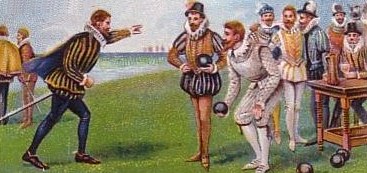
Sea captain, explorer, slave trader, privateer and pirate: Drake was all of these and more. To the Spanish he was a pirate (El Draque) but to the English, he was a hero. From the singeing of the King of Spain’s beard – his raid on Cadiz in 1587 – to his voyages around the world ( the first Englishman to do so) Drake was immensely popular.
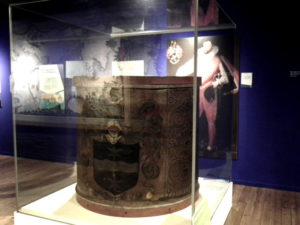
After his death a legend arose involving a drum, emblazoned with his coat of arms, that had reputedly accompanied him on all his voyages. This was an early European side drum, used on board ship for calls to arms or for entertainment; Drake was fond of music and on his circumnavigation, he took four viol players with him on the voyage. Whilst the drum dates from the 16th century, the coat of arms that decorates it was added in the 17th century.
It is generally believed that Drake’s drum was among the 13 drums rescued from Hawkins’ and Drake’s fatal last voyage to the Caribbean in 1596. Shortly before his death off the coast of Panama in 1596, it is said that he ordered the drum to be taken to Buckland Abbey, his home in Devon. He is said to have vowed on his deathbed that if England were ever in danger and the drum was sounded, he would return to defend his homeland.
Drake’s Drum on display at Buckland Abbey, before it was moved to The Box in Plymouth.
– when the Mayflower left Plymouth for the New World in 1620
– when Napoleon Bonaparte entered Plymouth harbour as a prisoner aboard the Bellerophon
– in 1914 on the outbreak of World War One
– in 1918 on HMS Royal Oak just before the surrender of the German fleet
– during the evacuation of Dunkirk in 1940.
Two British army officers also claimed they heard the drum beating during the Battle of Britain in September 1940. It was also said to have been heard beating quietly in 1982 during the Falklands War and on 7th July 2005 when London was hit by a terrorist attack.
The legend of Drake’s drum fits into the category of ‘king of the mountain’ or ‘sleeping hero’ folklore. These are tales of national heroes ready to awake at times of national need, such as the legend of King Arthur and his knights, sleeping in Avalon waiting to arise when required.
Drake’s role as a protector of England is first mooted in a poem written by Charles Fitz Geffrey only a few months after Drake’s death, ‘Sir Francis Drake, His Honourable Life’s Commendation And His Tragical Death Lamentation’. The last few lines of the poem seem to suggest that he is forever watchful over England:
“The sea no more, heaven then shall be his tomb
Where he a new made star eternally
Shall shine transparent to spectator’s eye
But shall to us a radiant light remain
He who alive to them a dragon was
Shall be a dragon unto them again
For with his death his terror shall not pass
But still amid the air he shall remain
This role continued because England wished it to be so! “
The legend was further reinforced in 1897 with the publication of Sir Henry John Newbolt’s famous poem, ‘Drake’s Drum’, some lines from which are quoted at the head of this article.
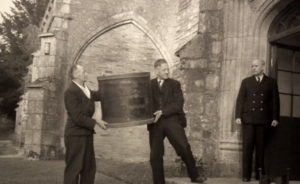
Drake’s Drum, arriving at Buckland Abbey from Plymouth City Museum, 1951
Sunday, January 26, 2020
A Study of African-American Drum and Bugle Corps and Their Communities
“I THINK WE SOUNDED BLACK!”
SPACE AND COMMUNITY IN BLACK DRUM AND BUGLE CORPS
By Jamil Jorge
Thesis submitted in partial fulfillment of the requirements for the degree of Master of Music in Music with a concentration in Musicology in the Graduate College of the University of Illinois at Urbana-Champaign, 2017, Urbana, Illinois
(Download Thesis here.)
ABSTRACT
This thesis examines three Black drum and bugle corps from the Civil Rights era of the nineteen-fifties and sixties: the Carter Cadets and the CMCC Warriors Drum and Bugle Corps from New York City, NY and the Washington VIPs from Washington, D.C.
It uses historical and ethnographic methods to present a history of Black corps, mainly based on interviews with alumni. By using theories of space and community, the goal is to analyze how urban planning made way for the formation of Black corps in inner cities.
These marching ensembles served two purposes within their communities: to teach youth valuable life skills to benefit their socioeconomic advancement, and to protect them from likely life-threatening situations, including drugs and violence, by showing them how to embrace their Black identities and create awareness of different opportunities.
The significance of this study is to present a little- researched performing ensemble within the United States, and base it historically during the Civil rights era to show one way Black communities coped with urban planning and the lack of socioeconomic opportunities in their neighborhoods.
Carter Cadets: https://youtu.be/dHFjBoCaAVs
CMCC Warriors: https://youtu.be/D_G_37ELM7M
Washington VIPs: https://youtu.be/_c47Vi1W6AM
A History of Rudimental Drumming in America
A HISTORY OF RUDIMENTAL DRUMMING IN AMERICA FROM THE REVOLUTIONARY WAR TO THE PRESENT
A Monograph
Submitted to the Graduate Faculty of the Louisiana State University Agricultural and Mechanical College in partial fulfillment of the requirements for the degree of Doctor of Musical Arts in The School of Music
by Eric Alan Chandler
B.S. Ball State University, 1983
M.M. Louisiana State University, 1985
May 1990
ABSTRACT
Rudimental drumming gained significance in America during the period of the Revolution. Ever since the late eighteenth century and through the nineteenth century, it was used exclusively in the military. This study traces the migration of drum rudiments and their use in military settings from Great Britain to America.
The contributions of the Swiss drummers and the incorporation of their drum music into American rudimental drumming are also examined.
The introductory chapter covers related pertinent and prefatory topics such as a definition of rudimental drumming, the duties of the military drummer, non-rudimental types of drumming and a summary of the origin and development of rudimental drumming in Europe.
The second chapter, which constitutes the body of the work, begins with an investigation of military drumming in America beginning in the Revolutionary War era and continuing through the nineteenth century. This chapter also includes calls, signals, and various rudiments used by the American military drummer as well as an analysis and inter pretation of the changes that took place in performance practices and notation.
The third chapter deals with rudimental drumming in the twentieth century beginning with the bands of John Philip Sousa, comparing techniques and principles of the past to modern marching percussion sections. Changes in rudiments during this century through the efforts of the National Association of Rudimental Drummers and the Percussive Arts Society are also examined.
The study concludes that many of the same rudiments and patterns used in Europe from the fifteenth century, and in America from the late eighteenth-century, are still used today and have remained unchanged. It has also been concluded that, in comparison to other countries, a large number of drum manuals have been published in America prior to the twentieth century.
A further conclusion acknowledges multiple applications of drum rudiments to other percussion instruments. Often, the work of any such project is measured in part by its usefulness and contribution.
This study will serve as a reference for the rudimental drummer as well as for the historian and could be used by scholars and instructors at all levels.
Download the work at https://pdfs.semanticscholar.org/0330/ec7999200db3b77c0e119ea6efeee71beb32.pdf
or https://www.dropbox.com/s/g9bn6fnwtmtlx2j/Chandler%20Thesis.pdf?dl=0.
Monday, January 13, 2020
Javier Morales performing "Andersonville"
Javier Morales performing "Andersonville" as a tribute to the legendary Bob Culkin at 4th Annual Drumming For Our Veterans, Jan. 11, 2020 produced by Chet DoBoe.
Sunday, January 12, 2020
Tuesday, June 4, 2019
Old School - 1965 Style & Technique for Drum Corps Drumming by Mike Stefanowicz
1965 Style & Techique for Drum Corps Drumming Pre-DCI Ludwig Drum & Bugle Corps Material
For purposes of preserving drumming history and heritage, style and technique, here is "Style & Technique for Drum Corps Drumming" by Mike Stefanowicz offered 1965 by "Ludwig Drum & Bugle Corps Educational Department (no copyright noticed). We found this gem on eBay and couldn't pass up the opportunity to buy and preserve its contents. Critical commentary encouraged."Mike Stefanowicz, is a national champion who became a Ludwig clinician and wrote many method books and articles on style and technique." See www.dcxmuseum.org/assets/056-065,%20Chapter%206.pdf.
"Mike Stefanowicz starting making music at age 12, and by 1940 was known across the country as one of the best drummers in the activity. His skill was also recognized outside the United States. After finishing as the first runner up in the individuals at the American Legion national convention in Boston, he finished as first runner up in the World Senior Open Championships during the World’s Fair, in Flushing, NY. In addition to performing with several fife and drum corps, he performed with the Seattle Hurricanes drum and bugle corps. He also instructed the drum lines of the Hurricanes and Thunderbirds of Seattle." See http://www.worlddrumcorpshof.org/biographies.htm.
Thursday, April 18, 2019
JORDAN NOBLE: THE VENERABLE SOLDIER-STATESMAN
JORDAN
NOBLE: THE VENERABLE SOLDIER-STATESMAN
Jordan Noble's story as a slave-turned-soldier and
a loved citizen of New Orleans has been somewhat thoroughly documented. Noble was able to use his status as a patriot
and soldier of four wars (Battle of New Orleans/War of 1812, Seminole War in
Florida, Mexican War, and as part of both the Confederate and Union forces during
the Civil War) to gain freedom and social status that very few of his skin color
had at that time. His accomplishments and
unique circumstances positioned him as a celebrated member of New Orleans
society and a political leader of the free black community.
Jordan Noble's efforts as a political leader began
far before President Lincoln's 1863 Emancipation Proclamation, far before the
Thirteenth Amendment abolished slavery in 1865, and far before the Fourteenth
Amendment offered a guarantee of civil rights in 1868. Noble's well-publicized notoriety
as Andrew Jackson's drummer and his voluntary service in multiple wars to help whites
forge the American republic positioned him to astutely negotiate through the
class-based society which surrounded him. His words and actions were public proof
that People of Color were model citizens, eloquent speakers with social grace,
and true patriots deserving freedom and every natural right. His words and
actions were tools that greatly advanced the fight for those rights and equality
throughout America.
Noble attended the 1854 National Emigration
Convention of Colored People in Cleveland, serving as an elected officer on its
National Board of Commissioners and a Louisiana delegate. The delegates of that
convention created what was advanced as the first platform "ever
established by the colored people in any Convention in the United States."
That groundbreaking platform made a series of declarations which outlined
specific civil rights grievances and, among other things, insisted that
"man is by nature free," that whatever interferes with the natural
rights of man should "be met with adequate resistance," and demanded
"every political right, privilege and position," while pledging to
use "all honorable means, to unite us as one people, on this
continent."1
In 1865, the first year that "free blacks and
mullatoes of Louisiana" could legally meet in convention, Noble attended the
Convention of Colored Men of Louisiana in New Orleans. He served as President
pro-tem and Vice President of the Convention, in addition to serving as
President of the Convention's Committee of Rules and Regulations and as an
officer on multiple other committees developed to "promote the moral,
educational, and economic development of the black community." Noble and the
other delegates quickly formed the Equal Rights League of Louisiana as an
outgrowth of the National Equal Rights League, which was founded just three
months prior, and endorsed their adopted "Declaration of Wrongs and
Rights." (The National Equal Rights League served as a forerunner to the
NAACP.) The published minutes and an editorial in the New Orleans Tribune specifically recognized Noble's high level of
leadership activity and important part at the Convention. His work alongside
other notable southern-black soldiers turned political leaders, such as James
H. Ingraham and Oscar J. Dunn, helped to ensure the Convention's success and initiate
a well-defined, unified Civil Rights Movement in the years that followed. 2,
3
1Proceedings
of the National Emigration Convention of Colored People Held at Cleveland,
Ohio, On Thursday, Friday, and Saturday, The 24th, 25th, and 26th of August,
1854; A.A. Anderson Print, Pittsburg, 1854; ColoredConventions.org, 2016.
2“State Convention of the Colored People
of Louisiana, January 9th, 10th, 11th, 12th, 13th, and 14th, 1865” (New
Orleans, LA); Foner, Philip S. and George E. Walker, eds.; The Proceedings of the Black State Conventions, 1840-1865. Volume
2, 1979; ColoredConventions.org, 2016.
3"Editorial: The State Convention
of the Colored People of Louisiana", The
New Orleans Tribune; January 10-15,
1865.
Former Slave Jordan B. Noble’s Battle of New Orleans Commemorative Banner and Historic Snare Drum and Offered in May 4 Americana Auction
Subject matter specialists
and digital assets available:
Eric Bradley, Director,
Public Relations
214-409-1871; EricB@ha.com
Former Slave Jordan B.
Noble’s Battle of New Orleans Commemorative Banner and Historic Snare Drum and
Offered in May 4 Americana Auction
|
|
New Orleans resident’s
rare war drum offered at Heritage Auctions
DALLAS, Texas (April 15, 2019)
– On January 8, 1815, a teenage slave named Jordan Bankston Noble beat the call to arms and stood shoulder to shoulder
with U.S. troops determined to drive back the British Army during the Battle of
New Orleans.
Despite his age, Noble, just 14
years old, already had plenty of experience as a drummer in the War of 1812
under Major General Andrew Jackson’s 7th Regiment; his skills also
had played a crucial role in a December 1814 surprise attack against the
British.
More than 180 years later, Noble’s
personally owned circa 1830 snare drum, which he used to keep soldiers
marching in step during Second Seminole War of 1836, and two additional wars, and a prized Battle
of New Orleans presentation banner, come to auction May 4 in Heritage Auctions’
Americana
& Political Auction in Dallas and on HA.com.
“Without a doubt, Jordan
Noble’s life is a fascinating story of courage and perseverance,” said Tom
Slater, an expert and director of Historical Americana at Heritage. “Despite
serving his country, after the war, two of Noble's commanders took ownership of
him and his mother. It was through their efforts that Jordan became a free man
and a celebrated historic figure in New Orleans.”
Born a slave in Georgia in
1800, Noble was raised by his mother before he was sold to New Orleans resident
John Noble in 1812 who likewise fought at the battle in Jackson’s 7th
Regiment Louisiana Volunteer Infantry.
Because of his extreme patriotism, after the War of 1812,
Noble continued his military career as a drummer during the Second Seminole War
of 1836, the Mexican War (under Zachary Taylor) and the Civil War. At the
outbreak of the Civil War, he raised a company of freed African Americans (the
“Louisiana Native Guards”) to provide security and defense for the city of New
Orleans.
The drum offered at auction on May 4 is the one he played
from his time in the Seminole Wars to the end of his life in 1890. It is the
very same one Noble was seen with at the World's Industrial and Cotton
Centennial Exposition/New Orleans World’s Fair (1884). After his death, the
drum was publically exhibited at the Colonial Museum in New Orleans (1903) and
the Louisiana Purchase Exposition/St. Louis World's Fair (1904), before being
loaned to the Louisiana State Museum for more than a century and being on
permanent display for the majority of that time.
The exceptionally important military snare drum features a
Federal eagle and shield on a standard military blue background. The maker’s
label is inscribed in ink at the top "JB
Noble." Although some of the paint is worn
and chipped, the graphic eagle remains vivid and is surrounded by 24 stars (one
chipped away) representing the 24 states admitted between 1821 and 1836.
Noble’s commitment to this
country ran deep. Among his most prized possessions was a 42-inch by 45-inch
blue silk banner that, according to tradition, was made by the women of New
Orleans and presented to Andrew Jackson to honor and commemorate his victory at
the Battle of New Orleans. It is decorated with two horizontal ribbons within a
wreath inscribed “Andrew Jackson” and “1814 and 1815.” It is encased with a
printed testimonial to Noble, dated April 27, 1880, signed by two former
governors, three generals and a commodore.
Noble’s widow sold the banner
(and drum) sometime before 1903 to Gaspar Cusachs, who loaned it to the
Louisiana State Museum. The banner has been publically exhibited at the
Colonial Museum in New Orleans (1903), the Louisiana Purchase Exposition/St.
Louis World's Fair (1904), the Louisiana State Museum (1909) and the Capitol
Park Museum in Baton Rouge (2006-2016).
Noble became known as the “The
Drummer Boy of Chalmette” and was fondly called "Old
Jordan" in his later years. He was often seen and heard
playing the snare drum currently offered at auction, and would timelessly
recreate the famous drumbeat that was heard on the fields of Chalmette during
the Battle of New Orleans, along with the many other military beats he
performed throughout his service to this country.
Old Jordan became such a fixture
of New Orleans’ culture, the local newspaper, The Daily Picayune,
honored him and told the story of his life in an article published June 21,
1890, the day after his death.
Heritage Auctions’ auction
session featuring Jordan B. Noble’s personally
owned snare drum and his prized Battle
of New Orleans presentation banner begins at 11 a.m. CT, May 4 at Heritage
Auctions in Dallas with live bidding available worldwide through HA.com.
Heritage Auctions is the
largest fine art and collectibles auction house founded in the United States,
and the world’s largest collectibles auctioneer. Heritage maintains offices in
New York, Dallas, Beverly Hills, San Francisco, Chicago, Palm Beach, London,
Paris, Geneva, Amsterdam and Hong Kong.
The Internet’s most popular
auction-house website, HA.com, has over one million registered bidder-members
and searchable free archives of four million past auction records with prices
realized, descriptions and enlargeable photos. Reproduction rights routinely
granted to media for photo credit.
For breaking stories, follow us: HA.com/Facebook
and HA.com/Twitter.
Link to this
release or view
prior press releases.
Hi-Res images available:
Eric Bradley, Director,
Public Relations
C: 469-271-2849 or EricB@ha.com
Jordan B. Noble Owned Snare Drum: African American Drummer in the Battle of New Orleans/War of 1812
Up for Auction at Heritage.com
Born into slavery in 1800, Jordan Bankston Noble was only 14-years old when he became the drummer for General Andrew Jackson's 7th Regiment. Noble beat the call to arms for the troops at the Battle of New Orleans and stood with the members of his unit in defense against the British attack. General Jackson, Noble and the men of 7th Infantry were considered heroes by the residents of New Orleans. After the war, two of young Noble's commanders took ownership of him and his mother. It was through their efforts that Jordan became a free man and one of New Orleans' most celebrated 19th-century black musicians.
Because of his extreme patriotism, after the War of 1812, Noble continued his military career as a drummer during the Second Seminole War of 1836, the Mexican War (under Zachary Taylor) and the Civil War. At the outbreak of the Civil War he raised a company of freed African Americans (the "Louisiana Native Guards") to fight for the South. After Union General Benjamin Butler took control of New Orleans from the Confederacy, Noble then raised a new regiment that fought for the North. It was under Butler that Noble served as a Captain of the U. S. 7th Louisiana Regiment Infantry (African Decent). Upon returning to New Orleans after his military service, Noble rose to fame for his valor and commitment to his community.
Noble became known as the "The Drummer Boy of Chalmette" and was also fondly called "Old Jordan" in his later years. He was often seen and heard playing the snare drum currently offered at auction, and would even timelessly recreate the famous drumbeat that was heard on the fields of Chalmette during the Battle of New Orleans, along with the many other military beats he performed throughout his service to this country.
Noble became such a fixture of New Orleans' culture, the local newspaper, The Daily Picayune, told the story of "Old Jordan" and his "well-worn drum" in an article published June 21, 1890, the day after his death.
"He gave frequent "field music" entertainment with his historic drum that he carried with him throughout all his services, and many will remember the white-headed old man and his well-worn drum, so often seen during the exposition of 1884-1885. The famous drummer boy of New Orleans has gone to join his comrades of many campaigns. Peace to him and honor to the brave man who served his country so often and so well."
The drum offered at auction is the one Noble played from his time in the Seminole Wars to the end of his life in 1890. It is the very same one Noble was seen with at the World's Industrial and Cotton Centennial Exposition/New Orleans World's Fair (1884). After his death, his widow sold the drum to Gaspar Cusachs, who exhibited it at the Colonial Museum in New Orleans (1903) and the Louisiana Purchase Exposition/St. Louis World's Fair (1904), before loaning it to the Louisiana State Museum for more than a century.
It is an exceptionally important military snare drum, with the music store's label inscribed in ink at the top "JB Noble" and bearing the name "Klemm & Brother's, No 287 Market St. Philadelphia." Early Philadelphia directories listed the drum maker at 287 1/2 Market St. from 1828 thru 1843. Concurrent with those dates, a New Orleans directory listed a Klemm Brothers store at 45 Canal St. in 1832.
The drum, with Federal eagle and shield on a standard military blue background, features the eagle and shield along with standard tack decoration, drumheads, rope and leather tensioners and brass snare tensioner on the side. It is 16.5" tall, with a diameter of 16.75". Although some of the paint is worn and chipped, the graphic eagle remains vivid and is surrounded by 24 stars (one chipped away) representing the 24 states admitted between 1821 and 1836.
Provenance: The Gaspar Cusachs Collection, Louisiana State Museum, 1908-2016
Sunday, January 6, 2019
New Old Stock, In the Box, ca. 1998 or later McDonagh 10-hole Regimental Model Fife with Fingering Chart
A friend came upon a new, old stock, in the box, 10-hole McDonagh fife, Regimental Model, complete with fingering chart. And he gave it to me! How sweet is that?
If you can add any information about the fife, please chime in.
McDonagh Fifes
https://en.wikipedia.org/wiki/Fife_(instrument):EditIn 1958, a new model fife designed by fifer John McDonagh was manufactured in Germany. This model was used by the three corps affiliated with him: The New York Regimentals Fife and Drum Band, St. Benedict's Fife and Drum Corps and St. Anselm's Sr. Fife and Drum Corps. All were located in the Bronx, New York. These fifes were not otherwise available to the public. A short time later a second generation of model evolved, specifically labeled the McDonagh Model and made by Roy Seaman, a music repairman whom John befriended in Manhattan. This model quickly came into popularity. These fifes were mass-produced for sale to the entire fife and drum community. They were two-piece instruments with a dual conical bore – the foot joint tapered down from the joint to about an inch before terminus, where the bore cone reversed itself and opened up again slightly. They used the popular flute and piccolo designs of the 1830s, where "cone" flutes were the rage and most common. The cone flutes had fallen out of favor to the cylindrical flutes designed by Boehm, though fifes and piccolos remained popular among folk music performers.
If you can add any information about the fife, please chime in.
McDonagh Fifes
https://en.wikipedia.org/wiki/Fife_(instrument):EditIn 1958, a new model fife designed by fifer John McDonagh was manufactured in Germany. This model was used by the three corps affiliated with him: The New York Regimentals Fife and Drum Band, St. Benedict's Fife and Drum Corps and St. Anselm's Sr. Fife and Drum Corps. All were located in the Bronx, New York. These fifes were not otherwise available to the public. A short time later a second generation of model evolved, specifically labeled the McDonagh Model and made by Roy Seaman, a music repairman whom John befriended in Manhattan. This model quickly came into popularity. These fifes were mass-produced for sale to the entire fife and drum community. They were two-piece instruments with a dual conical bore – the foot joint tapered down from the joint to about an inch before terminus, where the bore cone reversed itself and opened up again slightly. They used the popular flute and piccolo designs of the 1830s, where "cone" flutes were the rage and most common. The cone flutes had fallen out of favor to the cylindrical flutes designed by Boehm, though fifes and piccolos remained popular among folk music performers.
As would be expected, these fifes were notably more internally in tune than most previous fifes, since the designs of the 1830s fell from favor, and had the added value of being tunable with each other (by sliding the joint or the head cork). In addition, they gave the player greater dynamic control and could be played even louder than traditional fifes, the result of the lower cone in the bore. At first, only six hole (Model J) fifes were made, but by 1960, McDonagh designed and Seaman manufactured a 10-hole (Model L). Two of the holes were used by RH2 – covering only one of the two produced F natural. Some players found this quite difficult, so eventually (c. 1970s), an 11-hole model was introduced, the Model M, with both the original double RH2 holes and an RH thumb hole to choose from for the F natural. These were actually ideas derived from several makers of the days of the 19th century, including Giorgi, even though there was no need for F natural in traditional fife music.
Around this time, Roy Seaman had been deeply involved in the making of piccolos under his name, the body style of which resembled the McDonagh Model fife. Roy decided to retire from actively manufacturing fifes and sold the operation of making McDonagh fifes to an apprentice, Larry Trout. Operating on his own, Trout soon chose to mark the fife with his own "fish" symbol, which replaced the script mark of Roy Seaman's name. In time, the quality of the instrument eventually suffered and other models of fifes began to emerge in the United States.
McDonagh had stayed uninvolved from active fife and drum performance, teaching and composition for many years. As new generations of fifers emerged, John remained reclusive to himself and a few close friends, preferring to stay in his apartment in mid-town Manhattan. That began to change in 1988 and John began to meet privately at his home with some former fifing colleagues and a few newer players. John also renewed his collaborative friendship with Roy Seaman, who was now living in Arizona.
In 1997, John McDonagh, along with a newly formed fife study group, decided that the time had come to make changes to the original 1960 ten-hole fife. A new manufacturer, Wilson Woods, with critical oversight from Roy Seaman once again, produced the new fife, designated the Regimental Model. Along with this new fife, a number of fingering changes were suggested to take full advantage of the improved design. For a number of years, both Larry Trout and Wilson Woods made McDonagh fifes jointly—Trout the fish-marked familiar McDonagh Model and Wilson the Regimental Model. Eventually, both men discontinued making fifes as of 2003.
Most recently, The Cooperman Company, founded by Patrick H Cooperman, took over the manufacture of McDonagh fifes. Cooperman had ventured himself into the concert-fifemaking world in about 1985 with his own version of a two-piece fife, as well as an acoustically correct one-piece version, through the assistance of a few key players. Though the fifes played and sold well, they had not reached the popularity of the McDonagh.
Subscribe to:
Posts (Atom)
Charles W. Dickerson Fife, Drum & Bugle Corps of New Rochelle, New York
(Summary by Perplexity.AI) The Charles W. Dickerson Fife, Drum & Bugle Corps is a historic musical group based in...
-
A READER WROTE : Hi. My name is Mike and I have a drum similar to the one you have posted in the link below ( http://blog.fielddrums.c...
-
Photo Credit: Mark Bugnaski | Kalamazoo Gazette Paula Metzner, Kalamazoo Valley Museum assistant director for collections, takes down a Civ...