There is a certain historic drum which has been attracting a certain amount of attention. I am hoping that you will take a look and tell me what you can. Here are a couple of photos from Standing Rock Indian Reservation (Sioux), taken before 1912.
First picture: http://amertribes.proboards.com/index.cgi?board=teton&action=display&thread=990&page=3 (Scroll down to the last photo.)
Second picture: http://amertribes.proboards.com/index.cgi?board=teton&action=display&thread=944&page=2 (Scroll down to “Reply 28”.)
The second picture is captioned “Dream Dance Drum” – a particular kind of drum associated with the Ojibwe tribe beginning about 1876 and spreading to other tribes thereafter.
However, it looks to me like the drum is a commercial bass drum - it differs quite a bit from photos of known Dream Dance Drums.
Any information you can provide will be greatly appreciated, especially if you can refer to any other online images that closely resemble this possibly mislabeled “Dream Dance Drum.”
Sincerely,
Clark Kimberling
“Build it and they will drum.” Dedicated to research, study and comparisons of field drums. Our purpose is to collect information about historical U.S. drums (manufacture, preservation, conservancy, repair, market) for use by scholars, collectors and others. Photographs of drums, and anything related, together with informative narratives, are welcome. Interested readers will find archived postings a good resource. Reach us at emirsky@gmail.com.
Thursday, February 2, 2012
Tuesday, January 31, 2012
St. Anselm's Drum by Ed "Pop" Classey
Unconfirmed information from George Kubicek (who calls this a "Larchmont Drum") to the effect that this drum now is located in California, and was made by Ed "Pop" Classey of Mt. Vernon, New York.
A reader (sm56) wrote: "It is my understanding that Moeller was making drums before they collaborated, and that collaboration did not last very long. Patsy Ellis at Cooperman has some great background on this."
Patsy Ellis of the Cooperman Drum Company shared this information with George Kubicek by email dated Jan. 18, 2012:
"I've never heard of the 'Continental Drum Company - Larchmont NY,' and I've never heard that Moeller ever made drums under another label, or in Larchmont NY.
"Moeller passed away in 1960, and as far as I ever heard based on family stories and stories from Dave Boddie, Moeller was in Mt Vernon until he went to the home/hospital near the end of his life.
"My mom remembers walking by his workshop on her way to school when she was young (her dad was in 596 corps with Moeller, so she was familiar with the drum shop).
"Whenever I see something that looks Moeller-like from the vicinity of Mt Vernon (Larchmont is very close by) I always tend to think of a Classey family connection, but that's just a personal reaction, no basis in fact; it's just that we know Pop Classey worked with Moeller on the 596 drums (my dad [Pat Cooperman] learned to drum from Pop Classey).
"[Pop Classey and Gus Moeller had a falling out, and Pop Classey went out on his own (according to Ed [Classey, Jr.]).
"The picture that was sent to us of this drum does shows what looks like a version of the Moeller strainer, although it looks a bit unpolished in the craftsmanship, and the shell looks generally like the old Mt Vernon drums made by Pop Classey and Gus Moeller, but not the same tack design.
"I'm sure you know the story that all the old Moeller St Anselm drums were taken "to the dump" before anyone who knew enough to try to save them could do anything about it, but again, I only know that as a story.
"I remember being told by Ed Classey[, Jr.] and Ed Olsen (and maybe Dave Boddie). I don't recall ever seeing a label inside a Moeller drum - the information was handwritten on the inside of the shell, and many times there are no markings at all, just the stories that everyone knows that so-and-so had drums from Moeller."
-----
Ivoryton Resident
December 16, 1995
Edward C. Classey Sr. of Falls River Circle, Ivoryton, died Thursday at Hartford Hospital. He was 75.
He was a self-employed carpenter in the area for many years. Most of his life he had been involved with fifing and drumming, belonging to the Ancient Mariners and the Sons of the Whiskey Rebellion. He was the owner of Ed Classey Drum Crafters in Ivoryton, and a member of the Company of Fifers.
http://articles.courant.com/1995-12-16/news/9512160358_1_drummers-fife-memorial
-----
Ed Classey[, Jr.] moved to Connecticut to join the Mariners.
As a boy, Ed's father [Ed ("Pop") Classey, Sr.] worked with Gus Moeller making the famous Moeller drums. Ed was a pure, old-time drummer. He became the principal composer of the Mariner drum beatings as the corps repertoire took shape. He had a pure Moeller approach that he had learned while drumming with Moeller as a child.
Connecticut's Fife & Drum Tradition
By James Clark
http://books.google.com/books?id=0hbpGKqUH64C&lpg=PA152&ots=XVHKz_ZzHK&dq=ed%20classey%20drum&pg=PA152#v=onepage&q=ed%20classey%20drum&f=false
As a boy, Ed's father [Ed ("Pop") Classey, Sr.] worked with Gus Moeller making the famous Moeller drums. Ed was a pure, old-time drummer. He became the principal composer of the Mariner drum beatings as the corps repertoire took shape. He had a pure Moeller approach that he had learned while drumming with Moeller as a child.
Connecticut's Fife & Drum Tradition
By James Clark
http://books.google.com/books?id=0hbpGKqUH64C&lpg=PA152&ots=XVHKz_ZzHK&dq=ed%20classey%20drum&pg=PA152#v=onepage&q=ed%20classey%20drum&f=false
-----
The St. Anselm Sound:
For the sound of St. Anselm's in 1955 (posted by George Carteris according to Bob Castillo, http://www.bobcastillo.org/) see http://youtu.be/zVJF3BqPxec and http://youtu.be/Pap3dQXSeqM (excellent stuff).
Uploaded by BronxFifer on Oct 7, 2009
This is St. Anselm's Drum Corps from the Bronx, NY playing "Old Comrades" and "Nulli Secundus" (Second to None) on bugle. The tape recording was made in the school gym sometime in 1955. The pictures are from the Company of Fifers & Drummers archives. Mostly they are photos from the late 1930's through 1941. The location or scene in many of the photos is Tinton Avenue in the South East Bronx. The drum corps existed from 1912 to about 1963.
-----
1955 This recording is of St. Anselm's Drum Corps from the Bronx, NY. from the original reel-to-reel tape. George was told the tape recording was made in the school gym. Pierce Gardener gave George the tape in 1994 and he had it transferred to a cassette tape. This recording is of the fife line playing "2nd Connecticut" and "Pride of the Bronx".
1955 St. Anselm's Drum Corps from the Bronx, NY
1955 This is a SECOND recording is of St. Anselm's Drum Corps from the Bronx, NY. from the original reel-to-reel tape. George was told the tape recording was made in the school gym. Pierce Gardener gave George the tape in 1994 and he had it transferred to a cassette tape. This recording is of the fife line playing "Old Comrads"
1955 St. Anselm's Drum Corps from the Bronx, NY Video #2
-----
The McDonagh Fife Used by St. Anselm's:
In the late 1950s a new model fife, designed by renowned fifer John McDonagh was manufactured in Germany. This model was used by the three corp's affiliated with John McDonagh. The New York Regimentals, St. Benedict's and St. Anselm's; all located in the Bronx, New York. These fifes were not otherwise available to the public. A short time later a second generation McDonagh Model evolved and made by Roy Seaman, and quickly came into popularity. These fifes were mass produced for sale to the entire fife and drum community. They were two-piece instruments with a dual conical bore - the foot joint tapered down from the joint to about an inch before terminus, where the bore cone reversed itself and opened up again slightly. They used the popular flute and piccolo designs of the 1830s, where "cone" flutes were the rage and most common. The cone flutes had fallen out of favor to the cylindrical flutes designed by Boehm.
http://en.wikipedia.org/wiki/Fife_(instrument)
Sunday, January 29, 2012
Conn 8 X 16" U.S. Marching Snare
eBay seller droopydrawers( 3162) near Knoxville, TN, is offering item no. 200686954454 with a BIN price of $285, described as follows: This is a Nice Conn Snare. 8 X 16" U.S. Marching snare. It is in Great condition, needs new heads,I cannot find any damage or extra holes.
Friday, January 6, 2012
1810 Abner Stevens Drum
John O'Neill, a regular on this website, wrote:
Please see attached photographs of an Abner Steven's 1810 field drum and drum sticks.
Drum heads measure approximately 15 ¾; in diameter by 15" tall with paper label affixed reading;
DRUM FACTORY
Abner Stevens,
has for sale
TAMBOURENS, BASS & COMMON
DRUMS
made in the best manner,
At his Factory in the centre of the town of
PITTSFIELD (Mass.)
1810
I don't know of another Stevens drum that is older. The overall condition of the drum is amazing for the age. I am not certain that the counter hoops are original, but they fit the drum perfectly. The bottom slunk head has a "Leedy" stamp and the rope looks to be hemp rope used by American drum makers in the 1930-40's.
Drumsticks measure approximately 17" long, dark stained wood , long taper. The drumsticks are very old and appear to match the age of the drum.
Please see attached photographs of an Abner Steven's 1810 field drum and drum sticks.
Drum heads measure approximately 15 ¾; in diameter by 15" tall with paper label affixed reading;
Abner Stevens,
has for sale
TAMBOURENS, BASS & COMMON
DRUMS
made in the best manner,
At his Factory in the centre of the town of
PITTSFIELD (Mass.)
1810
I don't know of another Stevens drum that is older. The overall condition of the drum is amazing for the age. I am not certain that the counter hoops are original, but they fit the drum perfectly. The bottom slunk head has a "Leedy" stamp and the rope looks to be hemp rope used by American drum makers in the 1930-40's.
Drumsticks measure approximately 17" long, dark stained wood , long taper. The drumsticks are very old and appear to match the age of the drum.
Monday, November 14, 2011
Old Guard - "Thoughts From The Fringe"
written by SSG R.Andrews, SSG R. Ruddle
edited by SFC Reilly, SSG Jamison, SSG Waterman
THE UNITED STATES ARMY
OLD GUARD FIFE AND DRUM CORPS DRUMLINE
THE OLD GUARD STYLE
Read through a solo from one of the most unique marching percussion ensembles in the world. Steeped in tradition, the Old Guard Drumline is a living example of the origins of modern rudimental drumming. The drumline employs a conglomerate of styles to include traditional American rudimental drumming of the 18th & 19th centuries, Swiss, Scottish, and some modern rudimental concepts. The ensemble has been influenced by some of the great names of traditional rudimental drumming to include: Earl Sturtze, Bobby Thompson, Les Parks, John S. Pratt and Nick Attanasio, and it has also been influenced by some of the modern greats as well. Likewise the writing style of the drumline has been influenced by a wide variety of concepts. Whether it be a Swiss rudimental pattern followed by a Latin groove, or a Scottish roll passage with a contemporary flair, the Old Guard Drumline still remains a place where "Tradition Lives."
Monday, October 31, 2011
Wm. S. Tompkins Drum, July 4th, 1865
Historic 19th Century American Snare Drum. Very attractive drum in superb overall untouched condition, accompanied by a 4 7/8" X 6 3/4" period ink script note bearing the following information, headed "Green (Unable to decipher) Island / May 30, 1870, This drum was used by me (Wm Denice) in the first Memorial Day observation May 30th 1869, by order of J. A .Logan Commander G. A. R. I was Drummer boy in State of New York 1st Vol, in the Army of the Potomac '61 - '63. Wm Denice".
The drum itself is of a form normally encountered C. 1865 1870. 17 1/2" diameter, 14 1/2" high. Overall wonderful untouched condition. The heavy hoops, which utilize iron hooks for the ropes to pass through, are decorated with alternating painted red and black stripes. The body of the drum actually appears to be of veneered mahogany, with a few hairlines in the veneering but no loss and very sound. The area around the ivory air hole is decorated with inlaid light colored wood stars, diamonds and leaves. Visible through the air hole is the following in period ink script, "Wm. S. Tompkins & Sons / Makers / Yonkers, N. Y. / Drums of all Sizes Made to Order / July 4th / 1865." Most unusual as an ink script 'lable' but absolutely authentic. Retains what appears to be the original rope including decorative woven section. Also retains all of the original leather tighteners, although three are missing the bottom portions. Both heads also appear to be original with a small hole, with no loss, in the top, and an old repaired crack in the bottom. Retains the original snares. The first Memorial Day was observed at Arlington National Cemetery by Logan's order in 1868, however beginning in 1869 the observance began to spread throughout the northern states. A great drum with a superb history. Estimate: $6,000 - $8,000.
Heritage Auctions
http://historical.ha.com/c/item.zx?saleNo=6074&lotNo=52105
Lot no. 52105.
The drum itself is of a form normally encountered C. 1865 1870. 17 1/2" diameter, 14 1/2" high. Overall wonderful untouched condition. The heavy hoops, which utilize iron hooks for the ropes to pass through, are decorated with alternating painted red and black stripes. The body of the drum actually appears to be of veneered mahogany, with a few hairlines in the veneering but no loss and very sound. The area around the ivory air hole is decorated with inlaid light colored wood stars, diamonds and leaves. Visible through the air hole is the following in period ink script, "Wm. S. Tompkins & Sons / Makers / Yonkers, N. Y. / Drums of all Sizes Made to Order / July 4th / 1865." Most unusual as an ink script 'lable' but absolutely authentic. Retains what appears to be the original rope including decorative woven section. Also retains all of the original leather tighteners, although three are missing the bottom portions. Both heads also appear to be original with a small hole, with no loss, in the top, and an old repaired crack in the bottom. Retains the original snares. The first Memorial Day was observed at Arlington National Cemetery by Logan's order in 1868, however beginning in 1869 the observance began to spread throughout the northern states. A great drum with a superb history. Estimate: $6,000 - $8,000.
Heritage Auctions
http://historical.ha.com/c/item.zx?saleNo=6074&lotNo=52105
Lot no. 52105.
CW Field Drum
Civil War Infantry Snare Drum. 12 1/2" high, 15" diameter. Possibly slightly shortened during the period of use, as there are no interior reinforcing rims. Retains original heads including snares, top head break, with no loss, but shrunken. Light colored body, probably maple, with dark red hoops. The top hoop is missing a a 1/2" X 4" piece where one of the rope holes was drilled. The rope at that point is now held in place with a supplemental piece of wire attached to the adjacent ropes. The drum actually appears to have been struck, and continued in use after the 'field' repair. Body is decorated with narrow red and white vertical stripes flanking the air hole. The air hole is decorated with a red and white star with small brass tacks at each tip of the star. Drum is overall completely untouched and doubtless bears an interesting, but unknown, Civil War history. Estimate: $750 - $950.
Source: Heritage Auctions
http://historical.ha.com/c/item.zx?saleNo=6074&lotNo=52103
Lot no. 52103
Source: Heritage Auctions
http://historical.ha.com/c/item.zx?saleNo=6074&lotNo=52103
Lot no. 52103
CW Field Drum by E. Hopkins, Troy, NY
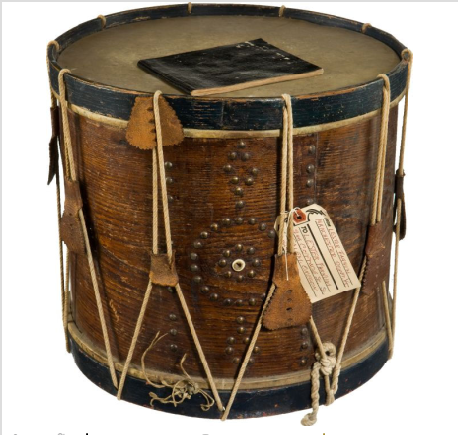
Very Nice Civil War Snare Drum With Interesting History 16 3/4" diameter, 15" high. Oak body with ivory air hole and nicely decorated with brass tacks. Black painted hoops. The drum is overall in excellent condition with nice untouched patina. Both heads are original and perfect. The ropes, while clearly quite old, are likely slightly later replacements, while the nicely decorated leather tighteners are period, all present, one torn, else all in excellent condition. Written in brown ink at two places on the bottom head, which retains the original snares, is the name "Albert Bates" with one of the names accompanied by "Weston". There is also a name applied in ink with a very small stencil to the top head. There is no interior lable. The drum is accompanied by a 5 3/8" X 6 5/8" heavy oil cloth covered music book with original orange paper lable on the inside cover, "Manufactured / By / E. Hopkins / 244 / River Street, Troy, N. Y." The book is printed with blank staffs which are then filled in with ink script drum beats to accompany identified pieces of music such as "Gen. Grant's Quick Step, Red, White and Blue, Funeral March" etc. An old shipping tag is also attached to the drum with "FROM Lester Farnum / Manchester Depot, Vt. TO Lester Farnum 245 Cottage St., So., Salem, Oregon." Very nice Civil War drum with a potentially very interesting history. Estimate: $1,600 - $1,800. Sold for $2,390.00 Nov. 12, 2011.
Source: Heritage Auctions
http://historical.ha.com/c/item.zx?saleNo=6074&lotNo=52100
Lot no. 52100
Source: Heritage Auctions
http://historical.ha.com/c/item.zx?saleNo=6074&lotNo=52100
Lot no. 52100
Regulation U.S. Marines Eagle Drum, ca. 1859
Exceptional Condition C.1859 Regulation US Marine Corps Eagle Drum. Certainly one of the finest specimens known of the handful of specimens extant. 14 1/2" diameter, 14" high. All paint correct and original and in superb condition. Retains what appear to be the original heads with just a couple of small holes at the edges. Ivory air hole, brass tack decoration, the body appears to be of maple. Original inner hoops, some pencil markings opposite the air hole, but no label. The ropes and tighteners are clearly an old restoration but extremely well done and detracts nothing. Generically probably the rarest of all US military regulation issue drums, this being a truly remarkable example. Estimate: $25,000 - $35,000.
Source: Heritage Auctions, Lot 52096.
http://historical.ha.com/c/item.zx?saleNo=6074&lotNo=52096
Source: Heritage Auctions, Lot 52096.
http://historical.ha.com/c/item.zx?saleNo=6074&lotNo=52096
Thursday, October 27, 2011
2-Ply Drum Shells -- When Did They Begin?
Martin Johncox of Boise, Idaho writes:
I am an avid drummer and would like to settle a disagreement. I think people were playing plywood-construction drums soon after the technology was developed in the 1850s, but some of my colleagues say Gretsch invented ply construction in the 1920s and before then, drums were solid shell or steambent.
I have looked online but there really isn’t much discussion about this kind of thing. Can you please clarify?
So, readers, any thoughts? Please email me at BlogMaster@FieldDrums.com.
Hint: I have two drums by Wm. S. Tompkins (ca. 1860) and they are definitely 2-ply cross-grain laminate shells.
I am an avid drummer and would like to settle a disagreement. I think people were playing plywood-construction drums soon after the technology was developed in the 1850s, but some of my colleagues say Gretsch invented ply construction in the 1920s and before then, drums were solid shell or steambent.
I have looked online but there really isn’t much discussion about this kind of thing. Can you please clarify?
So, readers, any thoughts? Please email me at BlogMaster@FieldDrums.com.
Hint: I have two drums by Wm. S. Tompkins (ca. 1860) and they are definitely 2-ply cross-grain laminate shells.
Tuesday, September 6, 2011
Noble & Cooley Bass Drum
Civil War Militia Bass Drum
Painted vignette with Patrotic Spreadwing Eagle clutching flag with unknows number of stars, (appears to be 20+ stars). Although the year 1812 is indicated thorough the peep hole, there is no maker's label. This drum was probably made in Granville Mass by Noble and Cooley C. 1860; replaced ropes and tension pulls; otherwise original. A very hard to find 24.25-inches tall x 33-inch diameter.
Price: $3,950
977-20
From website of Antique Associates of West Townsend, Inc.
Painted vignette with Patrotic Spreadwing Eagle clutching flag with unknows number of stars, (appears to be 20+ stars). Although the year 1812 is indicated thorough the peep hole, there is no maker's label. This drum was probably made in Granville Mass by Noble and Cooley C. 1860; replaced ropes and tension pulls; otherwise original. A very hard to find 24.25-inches tall x 33-inch diameter.
Price: $3,950
977-20
From website of Antique Associates of West Townsend, Inc.
Meacham Drum Sells for $475
American Furniture & Decorative Arts - Sale 2337 - Lot 897
Military Drum, Meacham and Company, Albany New York, probably third quarter 19th century, bentwood Civil War era drum with brass tack decoration and monograms "J.V.D.H.B.," red-painted rims, with rope and leather mounts, the interior with printed maker's label (probable old restring, bottom head replaced with wood), ht. 16 1/4, dia. 16 3/4 in.
Estimate $400-600
Sold for $475 by Skinner Auctioneers & Appraisers
Thursday, August 25, 2011
William Shute Tompkins - Biographical Information
ABRAHAM H. TOMPKINS.
More than two centuries and a half ago, in the year 1640, three brothers, Abraham, Joseph and John, came from England to America, braving the dangers incident to ocean voyages in those days when primitive methods of navigation were in vogue. One of the brothers was the father of Governor Daniel D. Tompkins, of New York. Abraham, the great-great-grandfather of our subject, located in Massachusetts, and had ason, also named Abraham, who was born in the town of Greenburg, Westchester county. New York. He became the owner of a large tract of land here, and at his death was buried in the cemetery at White Plains. He was loyal to the crown.
John Tompkins, his son, and the grandfather of our subject, was born in New York city and throughout his business career engaged in contracting and building. His political support was given the Whig party. He married Thama Shute, and they became parents of Abraham, William Shute and Mary Jones. The mother died, after which the father was married again, to Kathrine Yule, the children of the second union being John and Catherine, the latter the wife of Colonel Weeds, who is still living in Cincinnati, Ohio. Abraham Tompkins, the great-grandfather, was a very zealous church man of the Methodist Episcopal faith. He died in Westchester county and was laid to rest in White Plains.
William Shute Tompkins, father of our subject, was born August 22, 1812, in Sullivan street. New York city, and obtained his education in the
WESTCHESTER COUNTY. 841
public schools there. He learned the trade of cracker manufacturing and afterward that of cabinet-making. Later he added to the latter trade the conducting of furniture stores in different parts of the city, and at one time the celebrated W. M. Tweed, of political fame, was in his employ. Subsequently he engaged in the manufacture of drums at No. 69 Wall street, and soon took the leadership in that line. He became especially famous for the superior quality of his drums, some of which sold for as much as five hundred dollars. He had the monopoly on high-grade bass and tenor drums and made the first orchestra drum used in this country. He also took up the study of music and was able to play almost any kind of wind instrument.
In his youth it was a fondly cherished dream that he might some day become the leader of a fine band, and that dream was ultimately realized. He was chosen the leader of the old New York Band and was one of the most celebrated musical directors of the country.
His place of business became known as " The College," and was the most popular rendezvous for the musical fraternity of the city. For several years he led P. T. Barnum's band, and after his removal to Yonkers he organized the Yonkers Cornet Band.
He also engaged in the manufacture of drums in the city until within a short time prior to his death.
In his political views he was first a Whig and afterward a Republican. He took an active interest in public affairs, served as a member of the Irving Hose Company, and socially was connected with the Independent Order of Odd Fellows.
William Shute Tompkins married Martha A. Hatfield and to them were born six children: Gilbert H., who was born March 11, 1812; William E.; Frances H., wife of John H. Tremper; Mary A., wife of J. Henry Andrews, a wealthy builder of New York city and commodore of the New Rochelle Yacht Club; Abraham H.: and Mercy M., wife of Captain J. A. Sartorious, of the United States Armory of New York city. The mother of these children died in 1855, and Mr. Tompkins afterward married Louisa Walls, of Westchester county. They had two children: Vivian S., a graduate of the University of New York, who is now taking a post-graduate course preparatory to practicing medicine; and Martha. The father died in November, 1884, and by his side in the Sparta burying-ground [Scarborough, part of southern Ossining, New York, along Route 9] rests his wife, who died in 1855.
Of the maternal ancestry of Abraham H. Tompkins we have the following account. Gilbert Hatfield, the great-grandfather of our subject, had a son, Gilbert, who was born in New York city, but became a gentleman farmer at Scarboro, in the town of Ossining, Westchester county. He traced his descent back to Arthur Hatfield, who crossed the Atlantic to America and purchased lands at North Castle, in October, 1763. The old homestead, which is still standing, and which is called the Mansion House, was erected
842 WESTCHESTER COUNTY.
in 1795 and was used as an inn during the war of the Revolution. The barn, on account of its superiority over others of that day, was significantly styled "None Such." The farm comprised five hundred acres of land, and was one of the best in that section of the country. The owner, Arthur Hatfield, went to Nova Scotia, where he was appointed a firstlieutenant in the English army in 1744.
Gilbert Hatfield, the great-grandfather of our subject, married and had five children: William, John, Anna Townsend, ThamaSearles and Phoebe Tompkins, one of whose sons, Gilbert, married Martha Williams, who was of Holland Dutch extraction and held valid claims to the Holland throne but relinquished all such on coming to America. Her father, Arthur Williams, was born May 27, 1740, and on emigrating from Holland to America located in the town of Ossining, Westchester county.
He was very wealthy. He held a lieutenant's commission in the British army and was sent to Nova Scotia to drill Englishsoldiers. When twenty-two years of age he married a lady of eighteen, the wedding taking place in 1762. He died in the town of Ossining, in 1819, and his wife passed away in 1821. Their daughter, Martha Williams, became the wife of Gilbert Hatfield, and one of their daughters, Martha A., married William Shute Tompkins, father of our subject. The children of Gilbert and Martha (Williams) Hatfield, were Tamna Ann, Arthur, John and Martha A. Their father was the owner of a farm in the town of Sparta, and also on Sullivan street, New York city, but selling the latter property he removed to Sing Sing [about a mile north of the Sparta Cemetery], this state.
Abraham H. Tompkins, whose name introduces this sketch, was born in Bleecker street, New York city, January 2, 1844, moved to Sing Sing when seven years of age, then moved to Yonkers, at the age of ten, and has lived here ever since. He was engaged in music until the war, when he enlisted at Newburg, New York, as drum major of the One Hundred and Sixty-eighth Regiment of New York Volunteers, being discharged at Newburg, October 31, 1863, at the expiration of his term of service. He was the youngest drum major in the war. He participated in the skirmish at Fort Magruder: in June, 1863, the engagements at Yorktown and Greenwich settlements.
In July the regiment was attacked by General Mosby, who after a short struggle was repulsed. Twenty of his men were captured, while the Union loss was only five. The regiment then left Yorktown to join the Army of the Potomac, and reached Gettysburg, July 6, 1863. In August, the Eleventh and Twelfth Corps were consolidated as the Twentieth Corps and sent to Georgetown, Alabama, whence the One Hundred and Sixty-eighth New York went to Newburg and was mustered out. From twenty to thirty-five years of age he was considered one of the best snare drummers in the world, if not the best.
Upon returning from the war Mr. Tompkins engaged in the butchering
WESTCHESTER COUNTY. 843
business, continuing in that line until 1896, when a horse falling upon him injured him so seriously that he was obliged to withdraw, and has since practically lived retired. He was a reliable, enterprising business man who won the public confidence and received a liberal patronage. He has always taken a zealous and active interest in everything pertaining to the welfare of the city, and is now serving as alderman from the fifth ward, to which position he was first elected in 1892. By re-election he is now serving his fourth term and as an alderman he has been aggressive and enterprising, always favoring improvement and reform. The erection of the public drinking fountains of Yonkers is credited to him, also the widening of the aqueduct arch; he is a strong advocate of public parks, and always advocated the equalization of water rates. In politics he has always been aRepublican, and belongs to the Lincoln Legion, a political organization, and the Young Men's Republican Club.
Mr. Tompkins is a charter member and one of the organizers of Retching Post, No. 60, G.A.R., which is now the fifteenth post on the roll. He was chairman of the memorial committee, G.A.R., May 30, 1895, and he has filled all of its offices, and is now serving his second term as commander.
He was chosen delegate to the state encampment at Syracuse in 1899. He is also a member of the Westchester County Association of Grand Army Posts, and was a member of Company H, Seventeenth Regiment, and afterward the Third Regiment of the state militia. Subsequently this became the Sixteenth Battalion, and of both he served as drum major. It is now known as the Fourth Separate Company, and Mr. Tompkins is still connected therewith,having for twenty years been a member of the state militia. He is a valued member of the Patriotic Order Sons of America, formerly belonged to the Knights of Pythias fraternity and also the United American Mechanics, the Independent Order of Odd Fellows and was the department commander.
He served as aide on the staff of Charles Freeman and Jack Adams, and as aide-de-camp on the staff of Thomas Lawler, commander in chief. He took an early interest in the movement toward securing the Yonkers soldiers' monument, and served as chairman of the committee from Retching Post, No. 60, G.A.R.; on the entertainment committee at the unveiling ceremonies.Also he is a member of the Veteran Association of the national guard, S.N.G. In religion he is a member of the Methodist church.
On the 7th of April, 1867, Mr. Tompkins married Miss Eliza L. Nuskey, a daughter of Captain Alfred Nuskey, captain of the Lockwood Guards. Her mother bore the maiden name of Susan Tillottson and was a daughter of Rachel Lambert, whose father, William Lambert, belonged to a prominent old Knickerbocker family, and served for seven years as a sergeant in the American Revolution. He was married October 11, 1790, to Elizabeth Cypher.
844 WESTCHESTER COUNTY.
who was born April 21, 1761, and was of Scotch descent. They were very aristocratic people and possessed considerable wealth, living in very luxurious style for those days. They were also very charitable, and generous in their giving. Their daughter, Rachel, was born October 3, 1790, and married William Tillottson, by whom she had the following children: Susanna, Lavinia, James, Catherine, Nancy, Benjamin and Nathaniel. Mr. Tillottson died October 6, 1865, and his wife in January, 1874. He had served in the operations along Lake Ontario in the war of 1812, was taken prisoner and sent to Boston, where he was exchanged after peace was declared. His daughter, Susan, was born April 2, 1816, and married Alfred Nuskey, who was born in Philadelphia, Pennsylvania, in August, 181 5. Their children were Mrs. Catherine Knapp; Clorinda W.; Mrs. Rachel Ward; Eliza; Abraham H. T.; Emma,deceased; and Granville. The mother of these children died December 15, 1888, but Mr. Nuskey is still living at the age of eighty-four years. He makes his home in Sing Sing, New York, where for many years he served as foreman of the Brand nith Mills. He is a very zealous member of the Methodist Episcopal church, is a local preacher of that denomination and is very popular in church circles. His life has been well spent and 'all esteem him highly for his sterling worth. His daughter, now Mrs. Tompkins, was born June 22, 1848. By the marriage of our subject and his wife have been born three children: Gertrude I.; William N., who married Miss Jennie Stainsby, of Brooklyn, and resides in Yonkers with his wife and daughter, Gertrude E. ; and Abraham H., Jr. The family is one of prominence in the community and its members occupy social positions of distinction.
Biographical Sketch of Westchester County, Illustrated, Vol. II, Chicago: The Lewis Publishing Company, Cornell University Library.
http://www.archive.org/stream/cu31924092224322/cu31924092224322_djvu.txt
More than two centuries and a half ago, in the year 1640, three brothers, Abraham, Joseph and John, came from England to America, braving the dangers incident to ocean voyages in those days when primitive methods of navigation were in vogue. One of the brothers was the father of Governor Daniel D. Tompkins, of New York. Abraham, the great-great-grandfather of our subject, located in Massachusetts, and had ason, also named Abraham, who was born in the town of Greenburg, Westchester county. New York. He became the owner of a large tract of land here, and at his death was buried in the cemetery at White Plains. He was loyal to the crown.
John Tompkins, his son, and the grandfather of our subject, was born in New York city and throughout his business career engaged in contracting and building. His political support was given the Whig party. He married Thama Shute, and they became parents of Abraham, William Shute and Mary Jones. The mother died, after which the father was married again, to Kathrine Yule, the children of the second union being John and Catherine, the latter the wife of Colonel Weeds, who is still living in Cincinnati, Ohio. Abraham Tompkins, the great-grandfather, was a very zealous church man of the Methodist Episcopal faith. He died in Westchester county and was laid to rest in White Plains.
William Shute Tompkins, father of our subject, was born August 22, 1812, in Sullivan street. New York city, and obtained his education in the
WESTCHESTER COUNTY. 841
public schools there. He learned the trade of cracker manufacturing and afterward that of cabinet-making. Later he added to the latter trade the conducting of furniture stores in different parts of the city, and at one time the celebrated W. M. Tweed, of political fame, was in his employ. Subsequently he engaged in the manufacture of drums at No. 69 Wall street, and soon took the leadership in that line. He became especially famous for the superior quality of his drums, some of which sold for as much as five hundred dollars. He had the monopoly on high-grade bass and tenor drums and made the first orchestra drum used in this country. He also took up the study of music and was able to play almost any kind of wind instrument.
In his youth it was a fondly cherished dream that he might some day become the leader of a fine band, and that dream was ultimately realized. He was chosen the leader of the old New York Band and was one of the most celebrated musical directors of the country.
His place of business became known as " The College," and was the most popular rendezvous for the musical fraternity of the city. For several years he led P. T. Barnum's band, and after his removal to Yonkers he organized the Yonkers Cornet Band.
He also engaged in the manufacture of drums in the city until within a short time prior to his death.
In his political views he was first a Whig and afterward a Republican. He took an active interest in public affairs, served as a member of the Irving Hose Company, and socially was connected with the Independent Order of Odd Fellows.
William Shute Tompkins married Martha A. Hatfield and to them were born six children: Gilbert H., who was born March 11, 1812; William E.; Frances H., wife of John H. Tremper; Mary A., wife of J. Henry Andrews, a wealthy builder of New York city and commodore of the New Rochelle Yacht Club; Abraham H.: and Mercy M., wife of Captain J. A. Sartorious, of the United States Armory of New York city. The mother of these children died in 1855, and Mr. Tompkins afterward married Louisa Walls, of Westchester county. They had two children: Vivian S., a graduate of the University of New York, who is now taking a post-graduate course preparatory to practicing medicine; and Martha. The father died in November, 1884, and by his side in the Sparta burying-ground [Scarborough, part of southern Ossining, New York, along Route 9] rests his wife, who died in 1855.
Of the maternal ancestry of Abraham H. Tompkins we have the following account. Gilbert Hatfield, the great-grandfather of our subject, had a son, Gilbert, who was born in New York city, but became a gentleman farmer at Scarboro, in the town of Ossining, Westchester county. He traced his descent back to Arthur Hatfield, who crossed the Atlantic to America and purchased lands at North Castle, in October, 1763. The old homestead, which is still standing, and which is called the Mansion House, was erected
842 WESTCHESTER COUNTY.
in 1795 and was used as an inn during the war of the Revolution. The barn, on account of its superiority over others of that day, was significantly styled "None Such." The farm comprised five hundred acres of land, and was one of the best in that section of the country. The owner, Arthur Hatfield, went to Nova Scotia, where he was appointed a firstlieutenant in the English army in 1744.
Gilbert Hatfield, the great-grandfather of our subject, married and had five children: William, John, Anna Townsend, ThamaSearles and Phoebe Tompkins, one of whose sons, Gilbert, married Martha Williams, who was of Holland Dutch extraction and held valid claims to the Holland throne but relinquished all such on coming to America. Her father, Arthur Williams, was born May 27, 1740, and on emigrating from Holland to America located in the town of Ossining, Westchester county.
He was very wealthy. He held a lieutenant's commission in the British army and was sent to Nova Scotia to drill Englishsoldiers. When twenty-two years of age he married a lady of eighteen, the wedding taking place in 1762. He died in the town of Ossining, in 1819, and his wife passed away in 1821. Their daughter, Martha Williams, became the wife of Gilbert Hatfield, and one of their daughters, Martha A., married William Shute Tompkins, father of our subject. The children of Gilbert and Martha (Williams) Hatfield, were Tamna Ann, Arthur, John and Martha A. Their father was the owner of a farm in the town of Sparta, and also on Sullivan street, New York city, but selling the latter property he removed to Sing Sing [about a mile north of the Sparta Cemetery], this state.
Abraham H. Tompkins, whose name introduces this sketch, was born in Bleecker street, New York city, January 2, 1844, moved to Sing Sing when seven years of age, then moved to Yonkers, at the age of ten, and has lived here ever since. He was engaged in music until the war, when he enlisted at Newburg, New York, as drum major of the One Hundred and Sixty-eighth Regiment of New York Volunteers, being discharged at Newburg, October 31, 1863, at the expiration of his term of service. He was the youngest drum major in the war. He participated in the skirmish at Fort Magruder: in June, 1863, the engagements at Yorktown and Greenwich settlements.
In July the regiment was attacked by General Mosby, who after a short struggle was repulsed. Twenty of his men were captured, while the Union loss was only five. The regiment then left Yorktown to join the Army of the Potomac, and reached Gettysburg, July 6, 1863. In August, the Eleventh and Twelfth Corps were consolidated as the Twentieth Corps and sent to Georgetown, Alabama, whence the One Hundred and Sixty-eighth New York went to Newburg and was mustered out. From twenty to thirty-five years of age he was considered one of the best snare drummers in the world, if not the best.
Upon returning from the war Mr. Tompkins engaged in the butchering
WESTCHESTER COUNTY. 843
business, continuing in that line until 1896, when a horse falling upon him injured him so seriously that he was obliged to withdraw, and has since practically lived retired. He was a reliable, enterprising business man who won the public confidence and received a liberal patronage. He has always taken a zealous and active interest in everything pertaining to the welfare of the city, and is now serving as alderman from the fifth ward, to which position he was first elected in 1892. By re-election he is now serving his fourth term and as an alderman he has been aggressive and enterprising, always favoring improvement and reform. The erection of the public drinking fountains of Yonkers is credited to him, also the widening of the aqueduct arch; he is a strong advocate of public parks, and always advocated the equalization of water rates. In politics he has always been aRepublican, and belongs to the Lincoln Legion, a political organization, and the Young Men's Republican Club.
Mr. Tompkins is a charter member and one of the organizers of Retching Post, No. 60, G.A.R., which is now the fifteenth post on the roll. He was chairman of the memorial committee, G.A.R., May 30, 1895, and he has filled all of its offices, and is now serving his second term as commander.
He was chosen delegate to the state encampment at Syracuse in 1899. He is also a member of the Westchester County Association of Grand Army Posts, and was a member of Company H, Seventeenth Regiment, and afterward the Third Regiment of the state militia. Subsequently this became the Sixteenth Battalion, and of both he served as drum major. It is now known as the Fourth Separate Company, and Mr. Tompkins is still connected therewith,having for twenty years been a member of the state militia. He is a valued member of the Patriotic Order Sons of America, formerly belonged to the Knights of Pythias fraternity and also the United American Mechanics, the Independent Order of Odd Fellows and was the department commander.
He served as aide on the staff of Charles Freeman and Jack Adams, and as aide-de-camp on the staff of Thomas Lawler, commander in chief. He took an early interest in the movement toward securing the Yonkers soldiers' monument, and served as chairman of the committee from Retching Post, No. 60, G.A.R.; on the entertainment committee at the unveiling ceremonies.Also he is a member of the Veteran Association of the national guard, S.N.G. In religion he is a member of the Methodist church.
On the 7th of April, 1867, Mr. Tompkins married Miss Eliza L. Nuskey, a daughter of Captain Alfred Nuskey, captain of the Lockwood Guards. Her mother bore the maiden name of Susan Tillottson and was a daughter of Rachel Lambert, whose father, William Lambert, belonged to a prominent old Knickerbocker family, and served for seven years as a sergeant in the American Revolution. He was married October 11, 1790, to Elizabeth Cypher.
844 WESTCHESTER COUNTY.
who was born April 21, 1761, and was of Scotch descent. They were very aristocratic people and possessed considerable wealth, living in very luxurious style for those days. They were also very charitable, and generous in their giving. Their daughter, Rachel, was born October 3, 1790, and married William Tillottson, by whom she had the following children: Susanna, Lavinia, James, Catherine, Nancy, Benjamin and Nathaniel. Mr. Tillottson died October 6, 1865, and his wife in January, 1874. He had served in the operations along Lake Ontario in the war of 1812, was taken prisoner and sent to Boston, where he was exchanged after peace was declared. His daughter, Susan, was born April 2, 1816, and married Alfred Nuskey, who was born in Philadelphia, Pennsylvania, in August, 181 5. Their children were Mrs. Catherine Knapp; Clorinda W.; Mrs. Rachel Ward; Eliza; Abraham H. T.; Emma,deceased; and Granville. The mother of these children died December 15, 1888, but Mr. Nuskey is still living at the age of eighty-four years. He makes his home in Sing Sing, New York, where for many years he served as foreman of the Brand nith Mills. He is a very zealous member of the Methodist Episcopal church, is a local preacher of that denomination and is very popular in church circles. His life has been well spent and 'all esteem him highly for his sterling worth. His daughter, now Mrs. Tompkins, was born June 22, 1848. By the marriage of our subject and his wife have been born three children: Gertrude I.; William N., who married Miss Jennie Stainsby, of Brooklyn, and resides in Yonkers with his wife and daughter, Gertrude E. ; and Abraham H., Jr. The family is one of prominence in the community and its members occupy social positions of distinction.
Biographical Sketch of Westchester County, Illustrated, Vol. II, Chicago: The Lewis Publishing Company, Cornell University Library.
http://www.archive.org/stream/cu31924092224322/cu31924092224322_djvu.txt
Saturday, July 23, 2011
Drum No. 1 of the Old Guard
Old Guard Fife and Drum Corps
Drum Number One, 1960
When the Corps was activated as part of Company H in 1960, Buck Soistman made a set of twenty-two traditional wooden rope-tension drums for it. The drums were in regular use until they were retired to the Old Guard Museum in 1989. Each drum is hand painted with the arms of the regiment and battle honors.
Source: The Old Guard Museum website.
Drum Number One, 1960
When the Corps was activated as part of Company H in 1960, Buck Soistman made a set of twenty-two traditional wooden rope-tension drums for it. The drums were in regular use until they were retired to the Old Guard Museum in 1989. Each drum is hand painted with the arms of the regiment and battle honors.
Source: The Old Guard Museum website.
Repurposing Antique Drums
Here's a creative (or sacrilegious) use of antique rope drums by Hudson Goods.
Drum End Tables
Visit our on-line store at HudsonGoods.com.
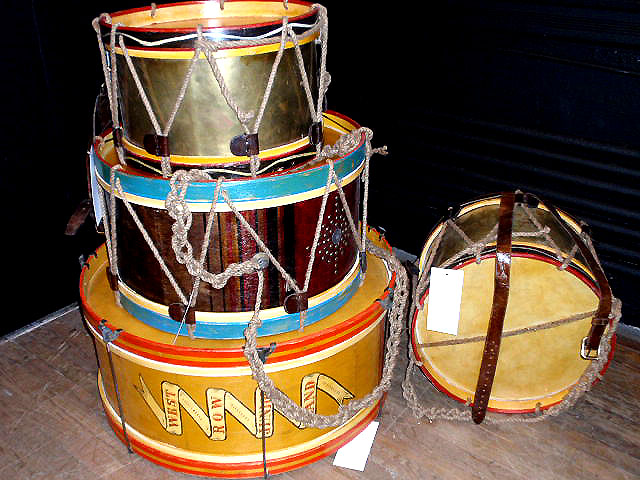
Who would have thought that you could turn a drum into an end table or even a hanging lamp? Well, now you can. These drums come in bright decorative colors with real leather straps and thick rope. So if you are musically inclined or always wanted to be in a marching band, check out these cool drums that are now being used for home furnishings.
These drums can be stacked in a corner, used as an end table by the sofa or even hung over the table for drum light dining. So go ahead and march to the beat of a different drummer!
Drum End Tables
Visit our on-line store at HudsonGoods.com.
Who would have thought that you could turn a drum into an end table or even a hanging lamp? Well, now you can. These drums come in bright decorative colors with real leather straps and thick rope. So if you are musically inclined or always wanted to be in a marching band, check out these cool drums that are now being used for home furnishings.
These drums can be stacked in a corner, used as an end table by the sofa or even hung over the table for drum light dining. So go ahead and march to the beat of a different drummer!
REGIMENTAL NEW YORK DRUM by WILLIAM MIXER
Estimate $1,500 - 2,500.
Realized $1,725.00
August 15, 2009
Fontaine's Antique Auction Gallery online
George B. Stone Drum
Civil War Style Marching Snare Drum, matching Leather Drum Sling and antique Rosewood drumsticks.
Beautiful Drum with Twenty-four (24) Rope Hooks, 12 Leather Ears, 17” Diameter Drum Heads and
Gut Snares. Original hemp rope. The drum heads are definitely 17" measuring across the heads from inside the rim.
The drum appears to be 100% original.
Gorgeous condition; the drum has a maple drum shell measuring 17” diameter by 12” deep, with original lacquered finish. Drum hoops maple are painted black on the outside and natural stain on the inside.
The famous George B. Stone and Son, Manufacturing Drummers, Boston Mass. metal badge affixed.
Hardware appears to be nickel plated; drum heads are in very good condition, drum plays amazing crisp and loud. Beatiful Rosewood drumsticks are antique, measuring 17-1/8" inches long.
Subscribe to:
Posts (Atom)
Charles W. Dickerson Fife, Drum & Bugle Corps of New Rochelle, New York
(Summary by Perplexity.AI) The Charles W. Dickerson Fife, Drum & Bugle Corps is a historic musical group based in...
-
A READER WROTE : Hi. My name is Mike and I have a drum similar to the one you have posted in the link below ( http://blog.fielddrums.c...
-
eBay seller kangel2 ( 1375) sold item no. 120553967399 for $485.00 on 4/12/10 described as: DRUMMER'S BUCKLE w/SLING AUTHENTIC CIVIL WAR...